U.S. flag

An official website of the United States government

Eastern Ecological Science Center

The USGS Eastern Ecological Science Center (EESC) strives to provide world-class science to inform natural resource decisions that preserve and enhance our quality of life. 

The land and water we live on and around shapes our lives. We share responsibility for the healthy fish, wildlife and landscapes that are assets to current and future generations.

EESC works directly with managers of our shared natural resources to provide the unbiased scientific tools, research and innovations needed to make informed decisions in today’s complex and rapidly changing conditions.

EESC’s broad expertise spans from mountain streams to deep oceans and the lands in between, supporting stewardship of a wide range of species and habitats.

Unique facilities in Maryland, Massachusetts and West Virginia help EESC deliver the reliable, actionable science that partners need to effectively conserve our treasured natural resources.

News

EcoNews - Vol. 7 | Issue 3

EcoNews - Vol. 7 | Issue 3

USGS Eastern Ecological Science Center at the 2026 Society of Environmental Toxicology and Chemistry North America Meeting

USGS Eastern Ecological Science Center at the 2026 Society of Environmental Toxicology and Chemistry North America Meeting

The Slime Trail: How USGS eDNA Efforts Are Revealing What Lives in the Deep Gulf

The Slime Trail: How USGS eDNA Efforts Are Revealing What Lives in the Deep Gulf

Publications

Highly pathogenic H5N1 avian influenza infection and exposure in waterfowl and waterbirds of the Sacramento National Wildlife Refuge Complex, 2022-2025 Highly pathogenic H5N1 avian influenza infection and exposure in waterfowl and waterbirds of the Sacramento National Wildlife Refuge Complex, 2022-2025

The introduction of clade 2.3.4.4b highly pathogenic avian influenza (HPAI) H5N1 into North America in 2021 marked a significant shift in disease dynamics for wild waterfowl populations. To assess infection and seroprevalence trends following this incursion, we leveraged ongoing capture efforts at the Sacramento National Wildlife Refuge Complex between October 2022 and July 2025 to...
Authors
Jeffery D. Sullivan, Rebecca L. Poulson, Michael L. Casazza, Elliott L. Matchett, Michael D'Errico, Alisha Bundy, Jacob William Chappell, Desmond Alexander Mackell, Andrea Mott, Cory T. Overton, David E. Stallknecht, Diann J. Prosser

Climate change is reshaping seagrass futures: Novel environments and opportunities along coastlines and across oceans Climate change is reshaping seagrass futures: Novel environments and opportunities along coastlines and across oceans

Seagrasses are a highly productive ecosystem that supports biodiversity and fisheries, protects coastlines, and buries globally significant carbon stocks. Because seagrasses are increasingly stressed by warmer, darker, and more variable waters, established management strategies may not guarantee future success. Here, we depict a global outlook for seagrass futures by synthesizing how...
Authors
Marc J.S. Hensel, Christopher J. Patrick, Christopher Brown, Jillian Dunic, Jonathan S. Lefcheck, Enie Hensel, Lina Mtwana Nordlund, Melisa C. Wong, Joel A. Carr, William C. Dennison, Katharina A. Engelhardt, Kendrick. Gary A., Karen McGlathery, Richard C. Zimmerman, David J. Wilcox, Robert J. Orth

Science

Exploring Wild Bird Movements to Understand Avian Influenza Risk for Poultry Farms on the Delmarva Peninsula
A recent collaborative study involving USGS, University of Delaware, University of California Davis, and Canadian colleagues used GPS tracking to learn how Canada Geese and Snow Geese use the landscape when wintering on the Delmarva Peninsula. These data were then used to understand location-based risk factors for the spread of Highly Pathogenic Avian Influenza Virus (HPAIV) to commercial poultry...
Exploring Wild Bird Movements to Understand Avian Influenza Risk for Poultry Farms on the Delmarva Peninsula

Exploring Wild Bird Movements to Understand Avian Influenza Risk for Poultry Farms on the Delmarva Peninsula

A recent collaborative study involving USGS, University of Delaware, University of California Davis, and Canadian colleagues used GPS tracking to learn how Canada Geese and Snow Geese use the landscape when wintering on the Delmarva Peninsula. These data were then used to understand location-based risk factors for the spread of Highly Pathogenic Avian Influenza Virus (HPAIV) to commercial poultry...
Learn More

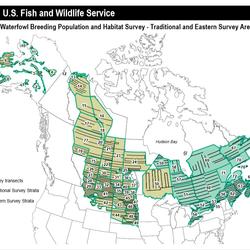
Redesigning the Eastern Breeding Waterfowl Population and Habitat Survey

USGS and partners are revising the design of a key waterfowl survey to increase management efficiency and cost-effectiveness, and inform annual harvest regulations in the U.S. and Canada.
Redesigning the Eastern Breeding Waterfowl Population and Habitat Survey

Redesigning the Eastern Breeding Waterfowl Population and Habitat Survey

USGS and partners are revising the design of a key waterfowl survey to increase management efficiency and cost-effectiveness, and inform annual harvest regulations in the U.S. and Canada.
Learn More

Evaluating the Design of the Waterfowl Breeding Population and Habitat Survey

The Waterfowl Breeding Population and Habitat Survey (WBPHS) is a primary source of waterfowl population status and trend information for management of ducks in North America. The survey has not been reviewed in several decades, and since the last review new analysis approaches and information needs have created a need to reassess the design, scope of inference, and analysis of the survey to...
Evaluating the Design of the Waterfowl Breeding Population and Habitat Survey

Evaluating the Design of the Waterfowl Breeding Population and Habitat Survey

The Waterfowl Breeding Population and Habitat Survey (WBPHS) is a primary source of waterfowl population status and trend information for management of ducks in North America. The survey has not been reviewed in several decades, and since the last review new analysis approaches and information needs have created a need to reassess the design, scope of inference, and analysis of the survey to...
Learn More
Was this page helpful?