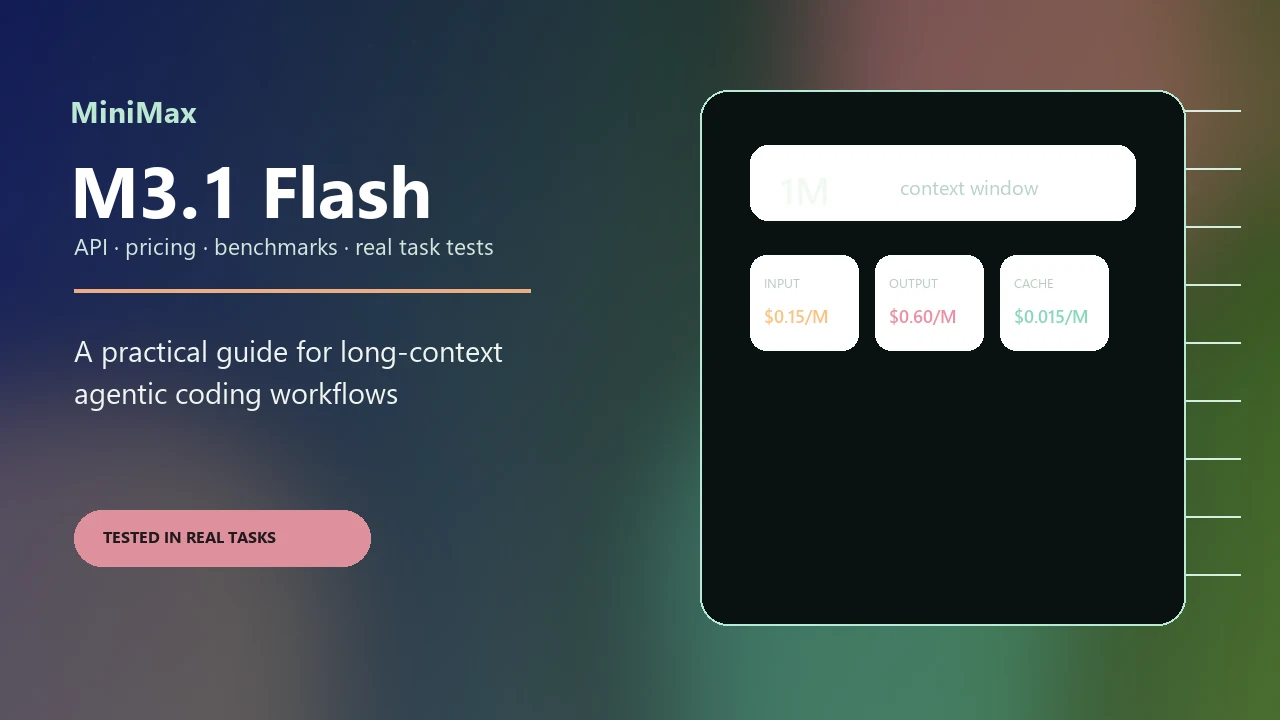
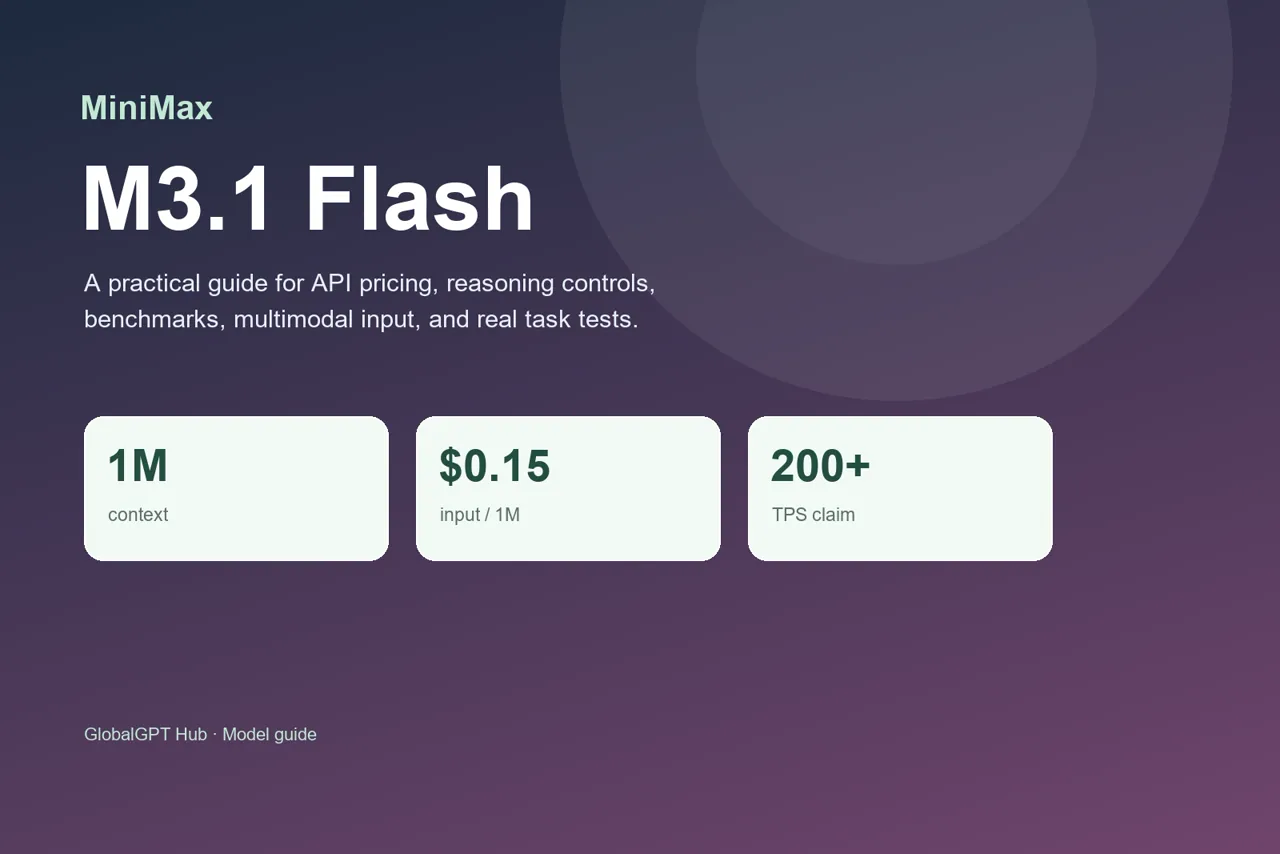
Quick answer: MiniMax M3.1 Flash is a low-cost, long-context model for coding agents, structured outputs, tool use, and multimodal workflows. The official API lists a 1M-token context window and $0.15 per 1M input tokens. Our three real-task checks completed successfully, but they are functional observations rather than a benchmark.
The useful question is whether the combination of price, context, thinking controls, and task behavior makes M3.1 Flash a sensible default. This review separates MiniMax’s published claims from our small test sample, then turns both into practical buying and API decisions.

Quick verdict
M3.1 Flash is worth testing when you need a large context window, structured agent behavior, and low direct API input cost. It is less compelling when you need an independently reproduced benchmark, a guaranteed free tier, or a production decision based on one short session.
MiniMax M3.1 Flash at a glance
MiniMax announced M3.1 Flash on October 19, 2026. The official invocation guide lists a 1M-token context window, always-on thinking, five effort levels, tool calls, and multimodal input limits.
1M tokens
Useful for large repositories, specifications, logs, and long agent state.
Five effort levels
Thinking stays on; choose effort according to task difficulty and review cost.
Text, images, video
Multimodal content is documented, but client serialization and file limits still need testing.
Agents and coding
Most interesting for structured coding, tool use, long documents, and diagnostics.
Pricing and cost examples
MiniMax’s official pricing overview lists $0.15 per 1M input tokens, $0.60 per 1M output tokens, and $0.015 per 1M cached input tokens. These are direct API rates, not a conversion of hosted-platform credits.
$0.15 / 1M
Uncached input tokens at the published direct API rate.
$0.60 / 1M
Completion tokens cost more, so cap output where the task allows it.
$0.015 / 1M
Stable prefixes can be cheaper when cache conditions apply.
Short agent turn
(0.1 × $0.15) + (0.02 × $0.60) = $0.027
Large context turn
(1 × $0.15) + (0.2 × $0.60) = $0.27
These are arithmetic estimates before taxes, retries, tool-side charges, discounts, or platform markup. The practical cost question is how much context you resend, how often you retry, and whether the output is constrained enough for downstream use.
API fit and parameters
MiniMax documents OpenAI-compatible and Anthropic-compatible interfaces. The example below uses the documented model ID and exposes reasoning effort and maximum completion tokens. Keep endpoint and parameter names aligned with the protocol you choose.
from openai import OpenAI

client = OpenAI(api_key="MINIMAX_API_KEY", base_url="https://api.minimax.io/v1")
response = client.chat.completions.create(
    model="MiniMax-M3.1-Flash",
    messages=[{"role": "user", "content": "Return valid JSON."}],
    reasoning_effort="medium",
    max_completion_tokens=1200,
)
print(response.choices[0].message.content)
For short structured tasks, start with lower effort and a bounded output budget. Raise effort only when the task needs deeper planning or debugging. A successful API call still needs application-level validation for JSON, tool arguments, citations, and privacy.
Official evidence and reported benchmarks
MiniMax’s launch announcement frames M3.1 Flash around agent performance, coding, computer use, cybersecurity, and lower inference cost. The benchmark figures are provider-reported claims, not independent reruns from this article.
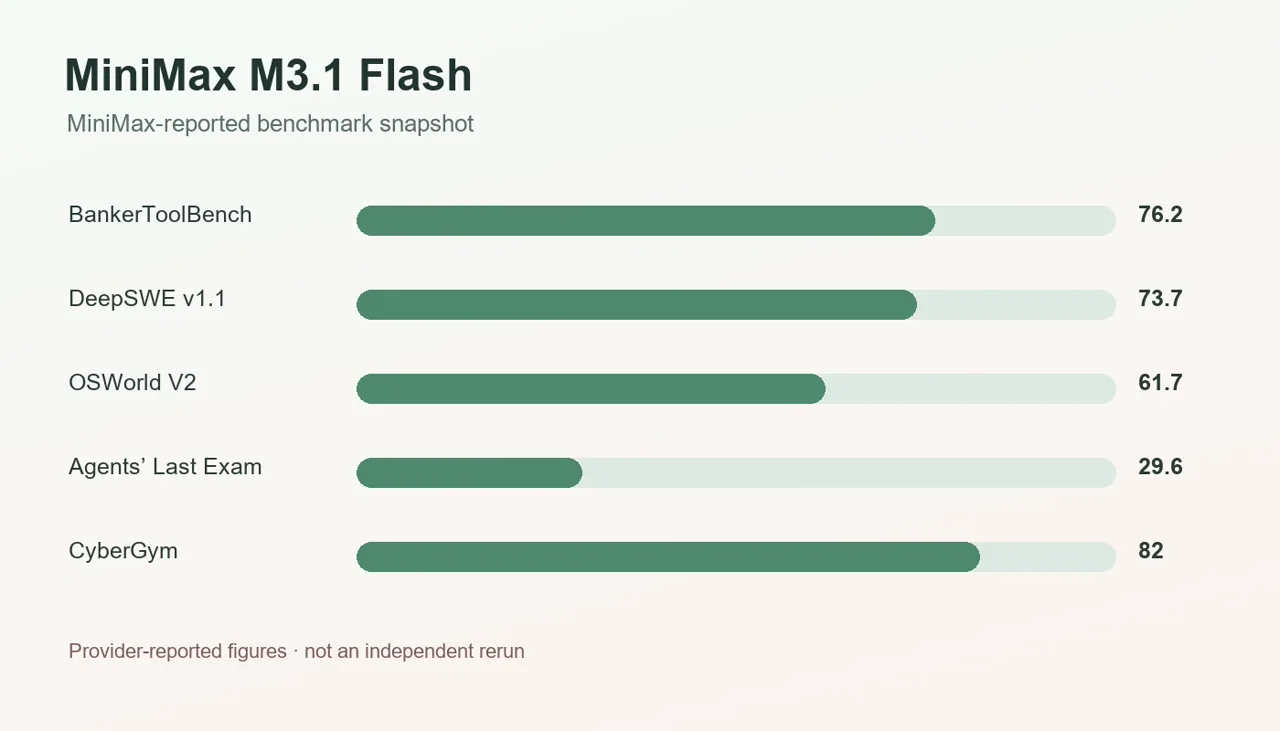

MiniMax’s official social account is @MiniMax__AI. It is useful for release updates, but an official announcement is not an independent user review. We do not present unverified social snippets as community consensus.
Our three real-task checks
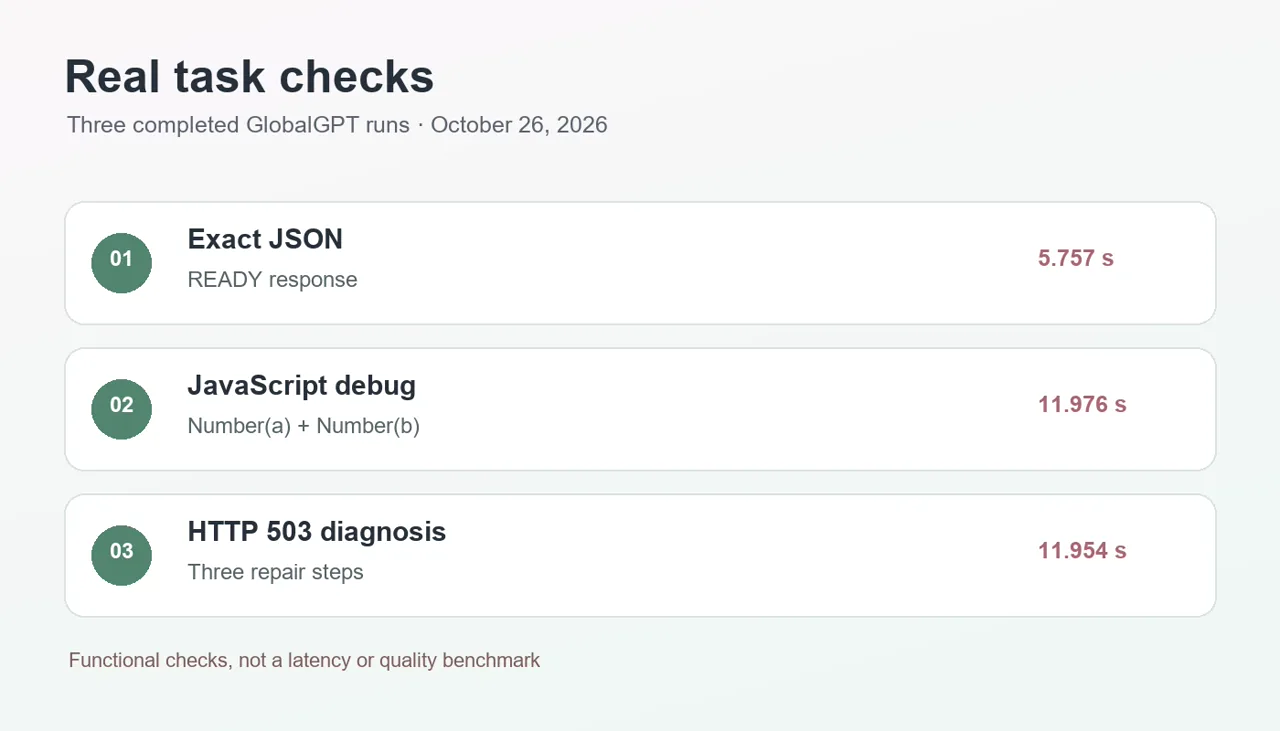
We ran three small tasks on October 26, 2026: exact JSON formatting, a JavaScript debugging fix, and a compact diagnostic response. Each completed successfully. These are functional observations from one test session, not a latency, quality, or cost benchmark.
Prompt
If copying is unavailable, select the text and press Ctrl/Cmd+C.Reply with exactly this JSON object and no markdown: {"status":"READY","model":"MiniMax M3.1 Flash"}{"status":"READY","model":"MiniMax M3.1 Flash"}What it shows: Strict output-shape following on a short task; it does not prove every larger response will parse cleanly.
Prompt
If copying is unavailable, select the text and press Ctrl/Cmd+C.A JavaScript function `sum(a, b)` returns the string concatenation `23` when called with 2 and 3. Give a minimal corrected function and one sentence explaining the bug. Use a fenced JavaScript code block.
function sum(a, b) {
  return Number(a) + Number(b);
}

The bug is that + concatenates when either operand is a string, so Number coercion makes the operation numeric.
What it shows: A minimal repair and explanation without expanding the task into an unrelated rewrite; this is not a general code-quality score.
Prompt
If copying is unavailable, select the text and press Ctrl/Cmd+C.Return a compact JSON array of exactly three objects with keys `step` and `action`, describing how to diagnose a failed HTTP 503 model request. Do not include markdown or extra text.
[
  {"step": 1, "action": "Capture the failure details and reproduce once."},
  {"step": 2, "action": "Check provider health, model availability, quota, and limits."},
  {"step": 3, "action": "Compare retries, a minimal request, and another model or region."}
]
What it shows: Three-object JSON shape plus a complete diagnostic outline; it is an instruction-following check, not proof of incident-resolution accuracy.
What the tests mean for a workflow
The strongest case for M3.1 Flash is a workflow where the model must hold a large context, follow an output contract, and complete a useful first pass before a human or tool validates the result. The weakest case is a workflow that treats a 1M context window or one successful turn as proof of production reliability.
Define the contract
Specify output shape, acceptance checks, and maximum useful context.
Tune the effort
Use a reasoning level that matches the cost of a wrong answer.
Validate the result
Parse JSON, test code, inspect tool arguments, and keep unsupported claims out of downstream actions.
M3.1 Flash vs the M3 workflow you already have
A model upgrade is only useful when it changes the work. If an existing M3 integration already meets its acceptance tests, the migration case is weaker than the headline specifications suggest. M3.1 Flash becomes more interesting when the workflow benefits from a larger context, adjustable effort, or more structured agent behavior.
- long context is part of the task
- you need effort controls
- structured outputs or tools are central
- input cost matters at volume
- your prompts and tool schemas are already validated
- the new model has no measured advantage on your workload
- migration testing would cost more than the expected savings
- you need a known fallback during rollout
Do not turn this into a numerical M3-versus-M3.1 leaderboard. The checked public material does not provide a like-for-like comparison under identical prompts and settings. A side-by-side staging run is the honest way to decide.
Failure modes to check before adoption
The three successful tasks are useful because they are small and inspectable. They are also limited. Before a production decision, add tests that expose the ways this model could be a poor fit for your system.
Send malformed and ambiguous cases. Check whether your parser can recover or whether the request must be retried.
Validate required fields, enum values, and refusal behavior before a tool call reaches a live system.
Compare full-context and retrieval versions of the same task. A larger window is useful only if the answer remains accurate and affordable.
Measure the cost and usefulness of a retry. A fast first response can still be expensive if the workflow needs several corrections.
These checks also keep the review honest. A model can produce a clean JSON object in a toy prompt and still fail when the input contains missing fields, contradictory instructions, or a tool schema that changed last week.
A practical decision framework
Start with the smallest acceptance test that represents the real job. Define what counts as correct before you compare models. For coding, that may be a passing test plus a minimal diff. For structured extraction, it may be valid JSON with every unknown preserved. For an agent, it may be a tool call that passes schema validation without an unsafe side effect.
- Freeze the task: use the same prompt, context, settings, and acceptance test for each model.
- Measure the whole path: include retries, review time, token cost, tool failures, and cleanup.
- Separate evidence: keep provider claims, one-off observations, and independent measurements in different columns.
- Roll out gradually: keep the current model as a fallback until the new route passes real workload checks.
That framework is more valuable than a single score because it tells you whether a model improves the work you actually pay to run. M3.1 Flash has enough documented capability and low input pricing to earn a staging test; the test still needs to earn the production rollout.
Access options
The direct API is usage-billed at the published token rates. MiniMax also lists M Plan and MiniMax Code as access routes, while hosted platforms can have separate plan terms and availability. The checked sources do not establish a universal free API tier.
For developers
Use when you need billing visibility, endpoint control, and integration into your own application.
Provider-native workflows
Check current inclusion, quotas, and region terms before treating access as part of a plan.
Fast trial
Useful for testing prompts before building an integration; verify current model-card terms.
Who should use it?
Good fit: coding agents, repository analysis, structured JSON workflows, long specifications, tool-using assistants, and teams that value low direct input cost.
Use caution: workloads that need an independently reproduced leaderboard result, guaranteed free access, fixed latency, or identical behavior across every compatibility layer.
Final verdict
MiniMax M3.1 Flash is a credible model to test when your workload is long-context, agentic, and cost-sensitive. Official evidence supports a 1M context window, adjustable thinking effort, multimodal input, and low direct input pricing. Our three tasks show useful instruction following and structured output behavior, but they do not establish a universal ranking or production guarantee.
If the workload fits that profile, open the GlobalGPT workspace and run your own acceptance test before moving real traffic. Compare the result against your current model using the same prompt, context, and review criteria.
FAQ
What is MiniMax M3.1 Flash?
MiniMax M3.1 Flash is a long-context reasoning model released on October 19, 2026 for coding agents, tool use, computer-use workflows, cybersecurity tasks, and structured workflows.
How much does MiniMax M3.1 Flash cost?
The checked direct API rates are $0.15 per 1M input tokens, $0.60 per 1M output tokens, and $0.015 per 1M cached input tokens. Hosted-platform pricing is separate.
Does it support a 1M context window?
Yes. MiniMax’s official invocation guide lists a 1M-token context window. Effective usable context still depends on request shape, tools, output budget, and client limits.
Is MiniMax M3.1 Flash free?
The direct API is usage-billed, and the checked sources do not establish a universal free API tier. M Plan, MiniMax Code, and hosted platforms can have separate terms.
Can I use the OpenAI SDK?
MiniMax documents an OpenAI-compatible interface with model ID MiniMax-M3.1-Flash. Validate the current endpoint, parameters, and response handling before production use.
What did the real tests show?
Three small tasks completed successfully: exact JSON, JavaScript debugging, and a three-step diagnostic response. They are functional observations, not a benchmark.
Who is it best for?
It is best suited to developers building coding agents, structured workflows, long-context assistants, and tool-using systems that can validate model output.
What should I test before adopting it?
Test representative prompts, context, JSON or tool contracts, retry behavior, output budgets, cost, and human review effort before routing production traffic.