

- Courses
- Tutorials
- Practice
- Jobs
Shortest Paths in Graphs Quiz
Question 1
Let G(V, E) an undirected graph with positive edge weights. Dijkstra's single-source shortest path algorithm can be implemented using the binary heap data structure with time complexity:
- A
O(| V |2)
- B
O (| E | + | V | log | V |)
- C
O (| V | log | V |)
- D
O ((| E | + | V |) log | V |)
Question 2
Given a directed graph where weight of every edge is same, we can efficiently find shortest path from a given source to destination using?
- A
Breadth First Traversal
- B
Dijkstra\'s Shortest Path Algorithm
- C
Neither Breadth First Traversal nor Dijkstra\'s algorithm can be used
- D
Depth First Search
Question 3
Let G=(V,E) be a directed, weighted graph with weight function w:E→R. For some function f:V→R, for each edge (u,v)∈E, define w′(u,v) as w(u,v)+f(u)−f(v). Which one of the options completes the following sentence so that it is TRUE ? “The shortest paths in G under w are shortest paths under w′ too, _________”.
- A
for every f:V→R
- B
if and only if ∀u∈V, f(u) is positive
- C
if and only if ∀u∈V, f(u) is negative
- D
if and only if f(u) is the distance from s to u in the graph obtained by adding a new vertex s to G and edges of zero weight from s to every vertex of G
Question 4
Which of the following is application of Breath First Search on the graph?
- A
Finding diameter of the graph
- B
Finding bipartite graph
- C
Both (a) and (b)
- D
None of the above
Question 5
Which one of the following algorithm design techniques is used in finding all pairs of shortest distances in a graph?
- A
Dynamic programming
- B
Backtracking
- C
Greedy
- D
Divide and Conquer
Question 6
Which of the following algorithm solves the all-pair shortest path problem?
- A
Prim’s algorithm
- B
Dijikstra’s algorithm
- C
Bellman-Ford’s algorithm
- D
Floyd-Warshall’s algorithm
Question 7
Consider a weighted undirected graph with positive edge weights and let uv be an edge in the graph. It is known that the shortest path from the source vertex s to u has weight 53 and the shortest path from s to v has weight 65. Which one of the following statements is always true?
- A
weight (u, v) < 12
- B
weight (u, v) ≤ 12
- C
weight (u, v) > 12
- D
weight (u, v) ≥ 12
Question 8
The Floyd-Warshall algorithm for all-pair shortest paths computation is based on:
- A
Greedy paradigm.
- B
Divide-and-Conquer paradigm.
- C
Dynamic Programming paradigm.
- D
neither Greedy nor Divide-and-Conquer nor Dynamic Programming paradigm.
Question 9
Consider the weighted undirected graph with 4 vertices, where the weight of edge {i, j} g is given by the entry
Wij in the matrix W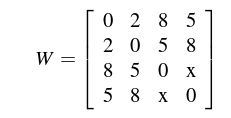
The largest possible integer value of x, for which at least one shortest path between some pair of vertices will contain the edge with weight x is ________
Note : This question was asked as Numerical Answer Type.
- A
8
- B
12
- C
10
- D
11
Question 10
Let G be a directed graph whose vertex set is the set of numbers from 1 to 100. There is an edge from a vertex i to a vertex j if either j = i + 1 or j = 3i. The minimum number of edges in a path in G from vertex 1 to vertex 100 is
- A
4
- B
7
- C
23
- D
99
There are 28 questions to complete.
