

- Courses
- Tutorials
- Practice
- Jobs
- Introduction of Finite Automata
- Arden's Theorem in Theory of Computation
- Solving Automata Using Arden's Theorem
- L-graphs in TOC
- Hypothesis (language regularity) and algorithm (L-graph to NFA) in TOC
- Regular Expressions, Regular Grammar and Regular Languages
- Identify a Regular Language.
- Designing Finite Automata from Regular Expression (Set 1)
- Star Height of Regular Expression and Regular Language
- Generating Regular Expression from Finite Automata
- Code Implementation of Deterministic Finite Automata (Set 1)
- Program for Deterministic Finite Automata
- DFA for Strings not ending with "THE"
- DFA of a string with at least two 0’s and at least two 1’s
- DFA for accepting the language L = { a<sup>n</sup>b<sup>m</sup> | n+m =even }
- DFA machines accepting odd number of 0’s or/and even number of 1’s
- DFA of a string in which 2nd symbol from RHS is 'a'
- Union Process in DFA
- Concatenation Process in DFA
- DFA in LEX code which accepts even number of zeros and even number of ones
- Conversion from NFA to DFA
- Minimization of DFA
- Reversing Deterministic Finite Automata
- Complementation process in DFA
- Kleene's Theorem in TOC
- Mealy and Moore Machines in TOC
- Mealy Machine vs Moore Machine
- Relationship between grammar and language in Theory of Computation
- Simplifying Context Free Grammars
- Closure Properties of Context Free Languages
- Union and Intersection of Regular languages with CFL
- Converting Context Free Grammar to Chomsky Normal Form
- Converting Context Free Grammar to Greibach Normal Form
- Pumping Lemma in Theory of Computation
- Check if the language is Context Free or Not
- Ambiguity in Context free Grammar and Languages
- Operator Grammar and Precedence Parser
- Context-sensitive Grammar (CSG) and Language (CSL)
- Introduction of Pushdown Automata
- Pushdown Automata Acceptance by Final State
- Construct Pushdown Automata for given languages
- Construct Pushdown Automata for all length palindrome
- Detailed Study of PushDown Automata
- NPDA for accepting the language L = {a<sup>n</sup>b<sup>m</sup> c<sup>n</sup> | m,n>=1}
- NPDA for accepting the language L = {a<sup>n</sup> b<sup>n</sup> c<sup>m</sup> | m,n>=1}
- NPDA for accepting the language L = {a<sup>n</sup>b<sup>n</sup> | n>=1}
- NPDA for accepting the language L = {a<sup>m</sup>b<sup>2m</sup>| m>=1}
- NPDA for accepting the language L = {a<sup>m</sup> b<sup>n</sup> c<sup>p</sup> d<sup>q</sup> | m+n=p+q ; m,n,p,q>=1}
- Construct Pushdown automata for L = {0<sup>n</sup>1<sup>m</sup>2<sup>m</sup>3<sup>n</sup> | m,n ≥ 0}
- Construct Pushdown automata for L = {0<sup>n</sup>1<sup>m</sup>2<sup>n+m</sup> | m, n ≥ 0}
- NPDA for accepting the language L = {a<sup>m</sup>b<sup>n</sup>c<sup>m+n</sup> | m,n ≥ 1}
- NPDA for accepting the language L = {a<sup>m</sup>b<sup>(m+n)</sup>c<sup>n</sup>| m,n ≥ 1}
- NPDA for accepting the language L = {a<sup>2m</sup>b<sup>3m</sup>|m>=1}
- NPDA for accepting the language L = {a<sup>m</sup>b<sup>2m+1</sup> | m ≥ 1}
- NPDA for accepting the language L = {a<sup>i</sup>b<sup>j</sup>c<sup>k</sup>d<sup>l</sup> | i==k or j==l,i>=1,j>=1}
- Construct Pushdown automata for L = {a<sup>2m</sup>c<sup>4n</sup>d<sup>n</sup>b<sup>m</sup> | m,n ≥ 0}
- NPDA for L = {0<sup>i</sup>1<sup>j</sup>2<sup>k</sup> | i==j or j==k ; i , j , k >= 1}
- NPDA for accepting the language L = {a<sup>n</sup>b<sup>2n</sup>| n>=1} U {a<sup>n</sup>b<sup>n</sup>| n>=1}
- NPDA for the language L ={wЄ{a,b}* | w contains equal no. of a's and b's}
- Turing Machine in TOC
- Turing Machine for addition
- Turing machine for subtraction | Set 1
- Turing machine for multiplication
- Turing machine for copying data
- Construct a Turing Machine for language L = {0<sup>n</sup>1<sup>n</sup>2<sup>n</sup> | n≥1}
- Construct a Turing Machine for language L = {wwr | w ∈ {0, 1}}
- Construct a Turing Machine for language L = {ww | w ∈ {0,1}}
- Construct Turing machine for L = {a<sup>n</sup> b<sup>m</sup> a<sup>(n+m)</sup> | n,m≥1}
- Construct a Turing machine for L = {a<sup>i</sup>b<sup>j</sup>c<sup>k</sup> | i*j = k; i, j, k ≥ 1}
- Turing machine for 1's and 2’s complement
- Recursive and Recursive Enumerable Languages in TOC
- Turing Machine for subtraction | Set 2
- Halting Problem in Theory of Computation
- Turing Machine as Comparator
Regular languages and finite automata
Question 1
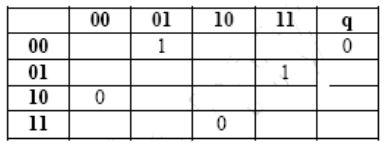
Consider the set of strings on {0,1} in which, every substring of 3 symbols has at most two zeros. For example, 001110 and 011001 are in the language, but 100010 is not. All strings of length less than 3 are also in the language. A partially completed DFA that accepts this language is shown below.
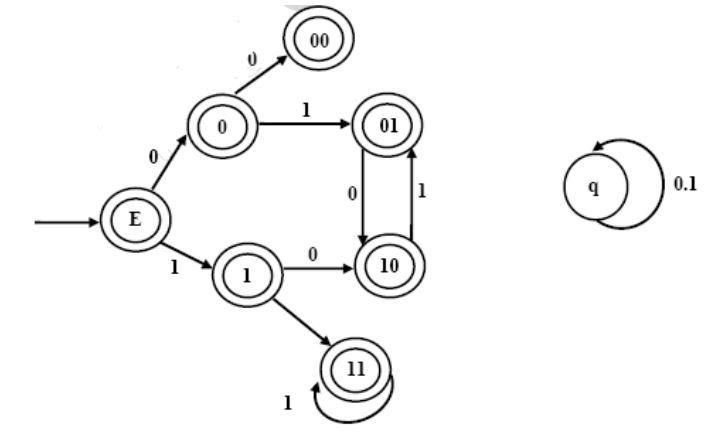
The missing arcs in the DFA are
- A
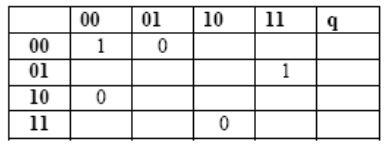
- B
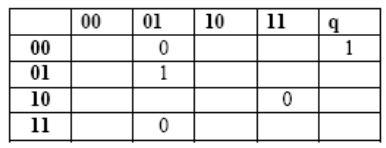
- C
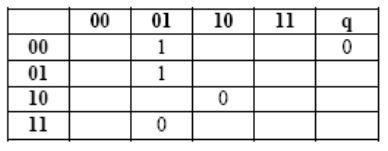
- D
Question 2
Consider the languages L1 = [Tex]\\phi [/Tex]and L2 = {a}. Which one of the following represents L1 L2* U L1*
- A
{[Tex]\epsilon [/Tex]}
- B
[Tex]\phi [/Tex]
- C
a*
- D
{[Tex]\epsilon [/Tex],a}
Question 3
Consider the DFA given.
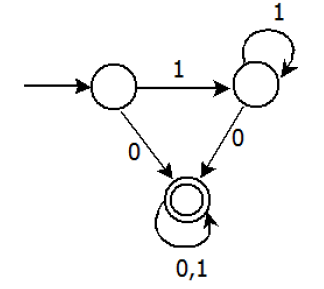
Which of the following are FALSE?
Complement of L(A) is context-free.
L(A) = L((11*0+0)(0 + 1)*0*1*).
For the language accepted by A, A is the minimal DFA.
A accepts all strings over {0, 1} of length at least 2.
Question 4
Definition of a language L with alphabet {a} is given as following.
L={|ank|k>0, and n is a positive integer constant}
What is the minimum number of states needed in DFA to recognize L?
- A
k+1
- B
n+1
- C
2(n+1)
- D
2[Tex](k+1)[/Tex]
Question 5
A deterministic finite automation (DFA)D with alphabet {a,b} is given below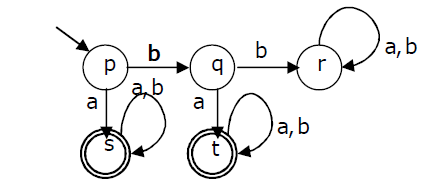
Which of the following finite state machines is a valid minimal DFA which accepts the same language as D?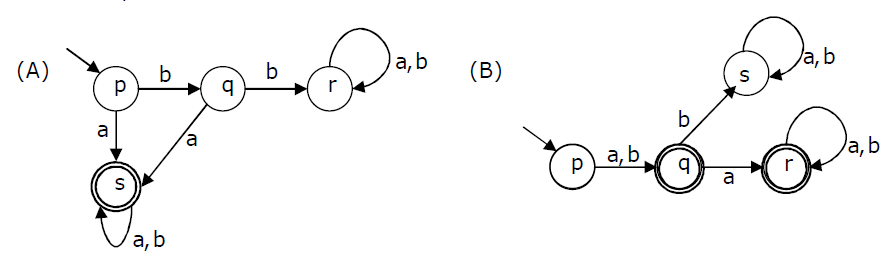
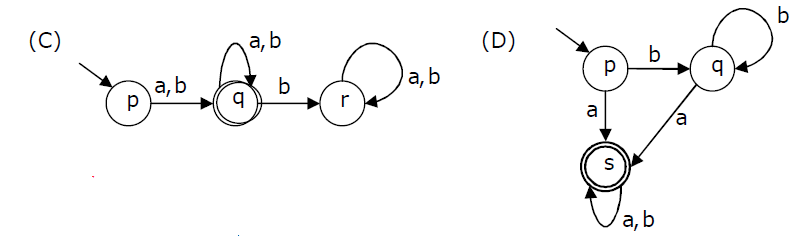
- A
A
- B
B
- C
C
- D
D
Question 6
Let w be any string of length n is {0,1}*. Let L be the set of all substrings of w. What is the minimum number of states in a non-deterministic finite automaton that accepts L?
- A
n-1
- B
n
- C
n+1
- D
2n-1
Question 7
Which one of the following languages over the alphabet {0,1} is described by the regular expression: (0+1)*0(0+1)*0(0+1)* ?
- A
The set of all strings containing the substring 00.
- B
The set of all strings containing at most two 0’s.
- C
The set of all strings containing at least two 0’s.
- D
The set of all strings that begin and end with either 0 or 1.
Question 8
The language [Tex]L=\{a^n b^n \mid n \geq 1\}[/Tex] is:
(GATE 2004 | MCQ | 1-mark)
- A
regular
- B
context-free but not regular
- C
context-sensitive but not context-free
- D
type-0 but not context-sensitive
Question 9
Given the following state table of an FSM with two states A and B, one input and one output:
| Present State A | Present State B | Input | Next State A | Next State B | Output |
0 | 0 | 0 | 0 | 0 | 1 |
0 | 1 | 0 | 1 | 0 | 0 |
1 | 0 | 0 | 0 | 1 | 0 |
1 | 1 | 0 | 1 | 0 | 0 |
0 | 0 | 1 | 0 | 1 | 0 |
0 | 1 | 1 | 0 | 0 | 1 |
1 | 0 | 1 | 0 | 1 | 1 |
1 | 1 | 1 | 0 | 0 | 1 |
If the initial state is A=0, B=0, what is the minimum length of an input string which will take the machine to the state A=0, B=1 with Output = 1?
- A
3
- B
4
- C
5
- D
6
Question 10
Given the language L = {ab, aa, baa}, which of the following strings are in L*?
abaabaaabaa
aaaabaaaa
baaaaabaaaab
baaaaabaa
There are 154 questions to complete.
