

Express.js is a lightweight and flexible web framework for Node.js used to build web applications and APIs. Its middleware-based architecture, routing capabilities, modular structure, and large Node.js ecosystem make it suitable for developing and integrating backend services in enterprise applications.
Express.js Supports Enterprise Application Development
Express.js provides the core features required to build backend applications while allowing developers to add libraries according to project requirements.
Some common uses include:
- REST API Development: Building APIs that allow different applications and services to communicate.
- Web Application Development: Handling server-side requests and generating responses.
- Microservices Development: Building independent services that communicate through APIs.
- Database Integration: Connecting applications with databases using appropriate drivers or libraries.
- Authentication and Authorization: Integrating libraries and middleware for securing application endpoints.
- Third-Party Integration: Connecting applications with external APIs and services.
Middleware Simplifies Application Development
Middleware functions execute during the request-response cycle and can perform common tasks before a request reaches the route handler.
Middleware can be used for:
- Request logging
- Authentication
- Authorization
- Input validation
- Error handling
- Parsing request bodies
Routing Organizes Application Endpoints
Express.js provides routing methods such as GET, POST, PUT, PATCH, and DELETE for handling different types of HTTP requests.
const express = require("express");

const router = express.Router();

router.get("/", (req, res) => {
    res.json({ message: "Employee list" });
});

module.exports = router;
Modular Structure Improves Application Organization
Enterprise applications generally contain multiple features and services. Express.js allows routes, middleware, controllers, and other application components to be organized into separate modules.
A project can be structured as:
project/
├── controllers/
├── middleware/
├── routes/
├── models/
├── services/
├── app.js
└── package.json
This separation helps developers maintain and extend different parts of the application independently.
Database Integration Supports Data-Driven Applications
Express.js does not provide built-in database functionality. Instead, applications can use database drivers or libraries to communicate with databases.
Express.js applications can integrate with databases such as:
- MongoDB
- MySQL
- PostgreSQL
- Redis
For example, MongoDB can be integrated using Mongoose, while MySQL can be accessed using packages such as mysql2.
REST APIs Connect Enterprise Services
Express.js can be used to create REST APIs that allow frontend applications, mobile applications, and other backend services to communicate with a server.
A typical API can handle operations such as:
GET     /api/employees
POST    /api/employees
PUT     /api/employees/:id
PATCH   /api/employees/:id
DELETE  /api/employees/:id
These endpoints can be connected to business logic and database operations.
Express.js Supports Microservices Architecture
Express.js can be used to build individual services in a microservices-based application. Each service can expose its own API and handle a specific business responsibility.
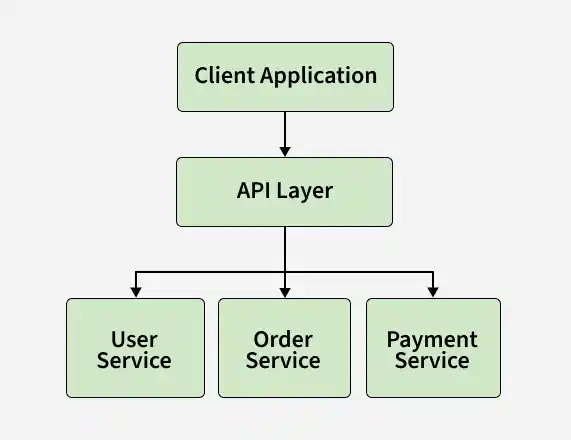
Each service can be developed and deployed independently while communicating with other services through APIs.
Node.js Ecosystem Extends Express.js Functionality
Express.js runs on Node.js and can use packages from the Node.js ecosystem. Developers can integrate additional libraries for features that are not provided directly by Express.js.
Common integrations include:
- Authentication: JWT, OAuth libraries, and authentication middleware
- Validation: Request and data validation libraries
- Logging: Application and request logging libraries
- Testing: Unit, integration, and API testing tools
- Databases: Database drivers and object-document/object-relational mapping libraries
- Security: Security-related middleware and libraries
- Request and data validation libraries
Express.js Can Be Integrated with Enterprise Infrastructure
Express.js applications can work with infrastructure components commonly used in larger systems, such as reverse proxies, load balancers, containers, cloud platforms, monitoring systems, and CI/CD pipelines.
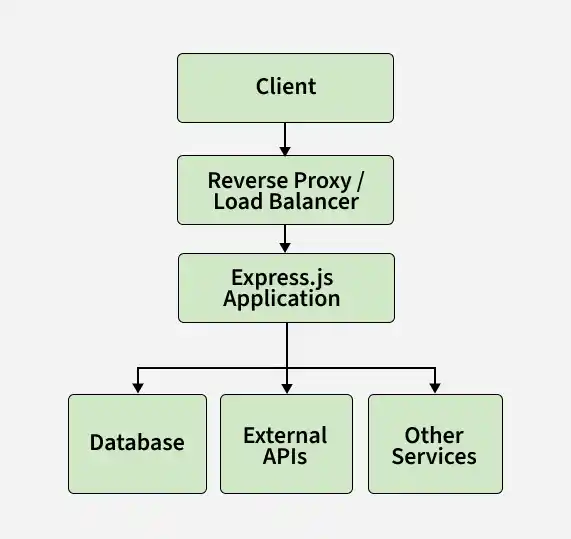
Express.js itself does not provide all these infrastructure capabilities, but it can operate as part of such an architecture.
Express.js Provides a Flexible Foundation for Enterprise Applications
Express.js is not an enterprise-specific framework. Instead, it provides a lightweight and flexible foundation that can be combined with other technologies to meet enterprise application requirements.
