

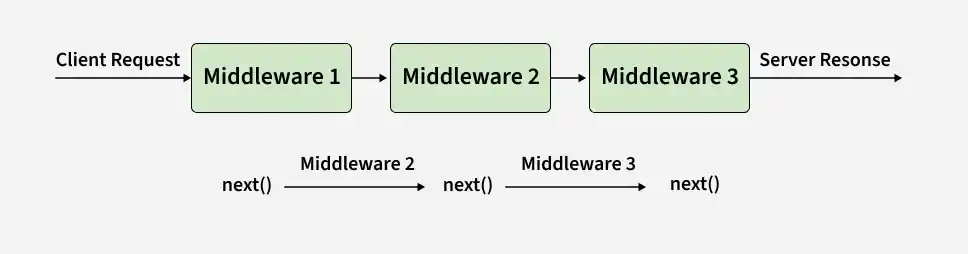
Express.js is the most powerful framework of the node.js. Express.js provides routing and middleware functionality for handling incoming client requests. Middleware functions execute during the request-response cycle and can process requests, modify responses, or pass control to the next middleware or route handler.
Custom Middleware
Custom middleware functions are created by developers to perform specific tasks during the request-response cycle. A custom middleware can process the request and response objects and use next() to pass control to the next middleware or route handler.
Syntax:
app.use(path, (req, res, next) => {
    // Middleware logic
    next();
});
Parameters: Custom Middleware takes the following two parameters:
- path: The path or path pattern for which the middleware will be called. It is optional when using app.use().
- callback: The middleware function that receives the request (req), response (res), and next() function as arguments.
Installation of the Express module
You can install this package by using this command.
npm install expressAfter installing the express module, you can check your express version in the command prompt using the command.
npm version expressAfter that, you can just create a folder and add a file, for example, index.js. To run this file you need to run the following command.
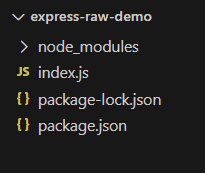
node index.jsProject structure:
Example : Create a custom middleware to log incoming requests:
// Requiring module
const express = require("express");
// Creating express app object
const app = express();
// Custom middleware
app.use((req, res, next) => {
    console.log(`Request received: ${req.method} ${req.url}`);
    next();
});
// Route handler
app.get("/gfg", (req, res) => {
    res.send("This is the GET request");
});
// Server setup
app.listen(3000, () => {
    console.log("Server is Running");
});
Steps to run the program:
Run index.js file using below command:
node index.jsOutput:
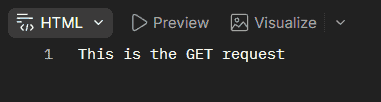
Server is RunningNow open the postman tool and send the following requests to http://localhost:3000/gfg
Console Output:

Postman Output:
Working of Custom Middleware
- A custom middleware function is created using app.use().
- The middleware receives req, res, and next as arguments.
- The middleware performs the required operation.
- Calling next() passes control to the next middleware or route handler.
- The route handler processes the request and sends the response.
- If the middleware sends a response, it should not call next() for normal request processing.
Use Cases of Custom Middleware
- Logging incoming requests.
- Validating request data.
- Implementing authentication and authorization.
- Modifying request or response objects.
- Adding custom headers to responses.
- Performing common processing before route handlers.
