

Prompt tuning can be approached in different ways depending on the task, the amount of context available and the type of reasoning required. The techniques range from simple instructions and examples to advanced methods that support multi-step reasoning, tool use, retrieval and automatic prompt optimization.
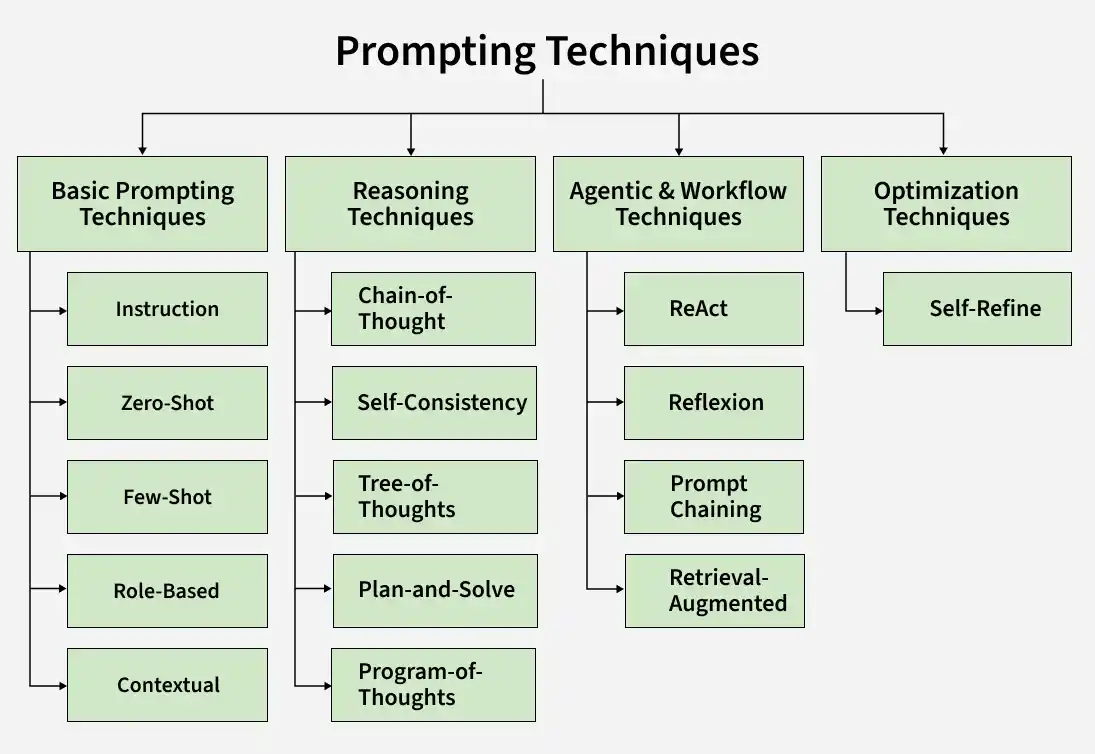
1. Instruction Prompting
Instruction Prompting gives the model a clear instruction describing the task it needs to perform. The instruction can specify the required action, input and desired output.
Example:
Summarize the following paragraph in three sentences.
The model follows the instruction and generates a summary based on the provided text.
2. Zero-Shot Prompting
Zero-Shot Prompting asks a language model to perform a task without providing any examples. The model relies on its pretrained knowledge and the instruction to determine how to complete the task.
Example:
Translate the following sentence into French: "Hello, how are you?"
Output:
Bonjour, comment allez-vous ?
Zero-shot prompting is useful when the task is simple and the model can understand the required behavior from the instruction alone.
3. Few-Shot Prompting
Few-Shot Prompting provides the model with a small number of examples before asking it to perform the task. These examples demonstrate the expected pattern, format or behavior.
Example:
English: Good morning
French: BonjourEnglish: Thank you
French: MerciEnglish: How are you?
French:
Output:
Comment allez-vous ?
Few-shot prompting is useful when the desired output format or task behavior is difficult to describe with instructions alone.
4. Role-Based Prompting
Role-Based Prompting assigns a role or perspective to the model to guide how it responds.
Example:
You are a Python instructor. Explain recursion to a beginner using a simple example.
The assigned role helps guide the response's style, level of detail and perspective.
5. Contextual Prompting
Contextual Prompting provides relevant background information along with the instruction so that the model can generate a more appropriate response.
Example:
You are helping a beginner learn Python. Explain why this code produces an error: [code].
The additional context helps the model understand the situation and tailor its response accordingly.
6. Chain-of-Thought Prompting
Chain-of-Thought (CoT) Prompting encourages a model to break a complex problem into intermediate reasoning steps before producing an answer. It is mainly useful for tasks involving mathematical, logical or multi-step reasoning.
Example:
Solve this problem step by step: If a book costs $15 and you buy 3 books, what is the total cost?
The model can break the calculation into smaller steps before giving the final answer:
3 × $15 = $45.
A related approach is Zero-Shot CoT, where the model is encouraged to reason through a problem without being given example solutions, often using an instruction such as "Let's solve this step by step."
7. Self-Consistency Prompting
Self-Consistency Prompting generates multiple possible reasoning paths for the same problem and selects the answer that appears most consistently among them.
Example:
For a mathematical problem, the model may generate several reasoning paths:
- Path 1 : 24
- Path 2 : 24
- Path 3 : 26
Since 24 occurs most frequently, the final answer is 24. This approach can improve reliability on tasks where different reasoning paths may produce different answers.
8. Tree-of-Thoughts Prompting
Tree-of-Thoughts (ToT) Prompting extends Chain-of-Thought by allowing the model to explore multiple possible reasoning paths rather than following a single sequence of steps.
For example:
When solving a puzzle, the model can explore several possible approaches, evaluate them and continue with the most promising one.
This makes ToT useful for problems where exploring alternative solutions is important.
9. Plan-and-Solve Prompting
Plan-and-Solve Prompting first asks the model to create a plan for solving a problem and then execute that plan.
The process can be represented as:
Problem → Create Plan → Execute Plan → Answer
Example:
Create a plan for calculating the total cost of five products with different prices and then solve the problem.
The model first identifies the required steps and then applies them to obtain the result.
10. Program-of-Thoughts Prompting
Program-of-Thoughts (PoT) uses generated programs or code to perform computational reasoning instead of relying entirely on natural-language reasoning.
Example:
For a mathematical problem, the model may generate code to calculate the result:
total = 25 * 4
print(total)
The program produces the numerical result, which can then be used in the final answer. PoT is particularly useful for mathematical and computational tasks.
11. ReAct Prompting
ReAct combines reasoning with actions. The model reasons about a task, takes an action such as calling a tool or retrieving information, observes the result and uses that information to determine its next action.
The general process is:
Reason → Act → Observe → Reason → Act
For example:
An AI assistant answering a weather question can determine that current information is required, use a weather tool, examine the result and then provide the answer.
ReAct is particularly useful for tool-using and agentic applications.
12. Reflexion
Reflexion enables an AI system to learn from feedback about its previous attempts. After completing a task, the system evaluates what went wrong or could be improved and uses that feedback in a subsequent attempt.
The process can be represented as:
Attempt → Feedback → Reflection → Improved Attempt
For example:
An AI coding agent can review an unsuccessful solution, identify the cause of an error and use that feedback to produce a better solution.
13. Prompt Chaining
Prompt Chaining divides a complex task into multiple prompts, where the output from one prompt becomes the input for the next.
Example:
For generating a technical article:
- Prompt 1: Generate an outline.
- Prompt 2: Write the introduction using the outline.
- Prompt 3: Develop the main sections.
- Prompt 4: Review and improve the article.
This approach makes complex tasks easier to manage by processing them through a sequence of smaller steps.
14. Retrieval-Augmented Prompting
Retrieval-Augmented Prompting provides a model with relevant information retrieved from external sources before generating a response.
The process can be represented as:
Query → Retrieve Information → Add Context → Generate Response
Example:
Using the following retrieved company policy, answer whether employees can work remotely on Fridays.
The model uses the retrieved policy as context instead of relying only on its pretrained knowledge. This approach is useful when responses need to be grounded in external, domain-specific or up-to-date information.
15. Self-Refine
Self-Refine allows a model to improve its own output through an iterative process. The model first generates an answer, evaluates it, identifies areas for improvement and then produces a revised version.
The process is:
Generate → Critique → Refine → Repeat
Example:
Write a product description.
The model first creates a description, critiques it for clarity and completeness and then rewrites it to improve the result. Self-Refine is useful for writing, coding and other tasks where the quality of an initial response can be improved through feedback.
16. Automatic Prompt Optimization
Automatic Prompt Optimization uses automated methods to generate, evaluate and improve prompts instead of relying entirely on manual prompt design.
A typical process is:
Generate Prompt → Test → Evaluate → Optimize → Repeat
For example:
An optimization system can generate several prompts for a classification task, evaluate their performance on a validation dataset and refine the best-performing prompt.
This approach is useful for developing effective prompts at scale and reducing manual trial and error.
Benefits
- Improved Task Performance: Appropriate prompting can help models produce more accurate and relevant responses.
- Better Control: Instructions, examples and context can guide the model toward a desired format or behavior.
- Better Reasoning: Techniques such as CoT, ToT and Plan-and-Solve can help with complex multi-step tasks.
- External Knowledge Integration: Retrieval-based techniques can provide information that may not be available in the model's internal knowledge.
- Flexible Workflows: Prompt chaining, ReAct and Reflexion can support complex tasks involving multiple steps and interactions.
Applications
- Question Answering: Prompting techniques can guide models to answer questions using instructions, examples or retrieved information.
- Content Generation: They can be used for writing articles, summaries, reports, emails and other forms of content.
- Code Generation: Reasoning and self-refinement techniques can help models generate, analyze and improve code.
- Data Analysis: Structured prompts and reasoning techniques can assist with interpreting and analyzing data.
- Customer Support: Contextual and retrieval-augmented prompting can help generate responses based on customer information and company knowledge.
- AI Agents: ReAct, Reflexion and prompt chaining can support systems that interact with tools and perform multi-step tasks.
