

Natural Language Generation (NLG) is a subfield of AI and Natural Language Processing (NLP) that generates human-readable text from data or other structured information. It is used in applications such as automated reports, chatbots and personalized emails.
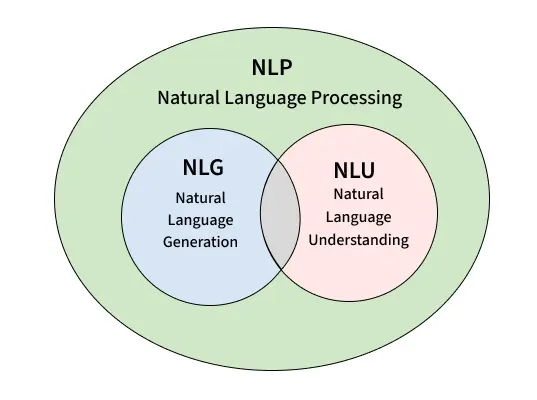
NLG focuses on generating language, while Natural Language Understanding (NLU) focuses on understanding language.
Example
Suppose a weather system provides the following structured data:
- Temperature: 32°C
- Condition: Sunny
- Wind Speed: 12 km/h
An NLG system can convert this data into a natural-language statement:
"Today will be sunny with a temperature of 32°C and winds of 12 km/h."
- Here, the system takes structured weather data as input and generates a readable sentence as output.
Working
- Content Determination: The system decides which information from the input data is relevant and should be mentioned. This involves filtering facts based on context or importance.
- Document Structuring: The content is organized into a continuous structure. Decisions are made about the order in which topics or facts should be presented.
- Aggregation: Facts are grouped to improve fluency and reduce redundancy. This ensures the text reads naturally, like how a human would summarize multiple data points.
- Lexicalization: Appropriate words and expressions are chosen to represent the facts.
- Referring Expression Generation: The system generates references to entities such as “it”, “they” or proper names to maintain clarity and consistency across the text.
- Linguistic Realization: Grammar rules are applied to construct well-formed sentences.
Types
NLG systems can be broadly classified based on how they generate text:
- Template-Based NLG: Uses predefined templates with variable fields that are filled using input data. It is simple, predictable and commonly used for structured reports.
- Rule-Based NLG: Uses manually defined linguistic and grammatical rules to generate text. It provides more control over the output but requires extensive rule design.
- Statistical NLG: Uses statistical models trained on data to learn patterns for generating text. These systems are more flexible than rule-based approaches but may produce less consistent output.
- Neural NLG: Uses neural networks and deep learning models to generate more fluent and natural text. Modern systems commonly use transformer-based language models.
- LLM-Based NLG: Modern NLG systems use Large Language Models (LLMs) based on Transformer architectures to generate human-like text for tasks such as question answering, summarization, translation and content generation.
Note: These categories can overlap in practice. Modern NLG systems may combine templates, rules and neural language models.
Evaluation Techniques
- Task-Based Evaluation: Measuring whether the text helps humans perform a specific task (e.g., decision-making from medical summaries).
- Human Judgment: Evaluators rate text quality based on fluency, coherence and informativeness.
- Automated Metrics: BLEU, ROUGE and METEOR compare generated outputs with reference texts written by humans, often used in summarization and translation tasks.
Applications
- Automated Reporting: Used in journalism, finance and weather forecasting to generate reports from structured data.
- E-Commerce and Product Descriptions: Generates descriptions for products using information from databases, reducing manual writing effort and maintaining consistency.
- Customer Service and Chatbots: Generates responses based on user input, intent and information from backend systems.
- Medical Reporting: Generates patient summaries and reports from structured Electronic Health Records (EHRs), helping reduce documentation workload for clinicians.
- Business Intelligence Dashboards: Converts data and trends into natural-language summaries, making insights easier for non-technical stakeholders to understand.
Challenges
- Factual Accuracy: NLG systems, especially neural and LLM-based systems, can generate information that is not supported by the input data. This is commonly referred to as hallucination.
- Context and Coherence: Maintaining the correct context and producing logically connected text can be difficult, especially for long or complex outputs.
- Controllability: It can be challenging to control the exact content, style, tone or structure of generated text. Research on controlled generation continues to address this problem.
- Evaluation: Automatically determining whether generated text is accurate, relevant and useful remains difficult. Traditional metrics such as BLEU and ROUGE do not capture every aspect of text quality.
- Bias and Domain Limitations: NLG systems can reproduce biases present in their training data and may perform differently across domains or languages.
Future Trends
- Controllable Generation: Future NLG systems are expected to provide better control over the content, tone, style, length and structure of generated text.
- Improved Factuality: Research is increasingly focused on reducing hallucinations and ensuring that generated text remains grounded in reliable information.
- Multimodal NLG: NLG systems are increasingly being combined with other modalities, allowing models to generate text based on information from images, audio, video and other data sources.
Differences between NLP, NLG and NLU
| Aspect | NLP | NLG | NLU |
|---|---|---|---|
| Input | Raw or structured language | Structured data | Natural language text |
| Output | Structured or unstructured text | Human-readable text | Machine-readable meaning |
| Goal | Interpret and produce language | Generate natural-sounding text | Understand meaning and intent |
| Techniques Used | Parsing, tagging, vectorization | Templates, language models, transformers | Syntax analysis, semantics, embeddings |
| Tasks | Translation, speech-to-text, summarization | Report writing, product descriptions | Intent detection, sentiment analysis |
| Examples | spaCy, NLTK, Hugging Face | GPT, T5, SimpleNLG | BERT, RoBERTa, Dialogflow |
| Evaluation Metrics | Accuracy, F1-score | BLEU, ROUGE | Precision, recall, intent accuracy |
