

The STRCMP() function in SQL is used to compare two strings. It returns a value based on whether the first string is equal to, less than or greater than the second string.
- Returns 0 when both strings are equal.
- Returns -1 when the first string is less than the second string.
- Returns 1 when the first string is greater than the second string.
Syntax
STRCMP(string1, string2)Where:
- string1: Specifies the first string to compare.
- string2: Specifies the second string to compare.
Note: STRCMP() is mainly supported in MySQL. SQL Server uses comparison operators such as =, < and >, while SQLite does not provide a built-in STRCMP() function.
Example 1: Compare Two Equal Strings
SELECT STRCMP('SQL', 'SQL') AS result;Output:

- Both strings are equal, so the function returns 0.
Example 2: Compare Two Different Strings
SELECT STRCMP('Apple', 'Banana') AS result;Output:

- Apple comes before Banana, so the function returns -1.
Example 3: Compare Strings from a Table
Consider the following products table:
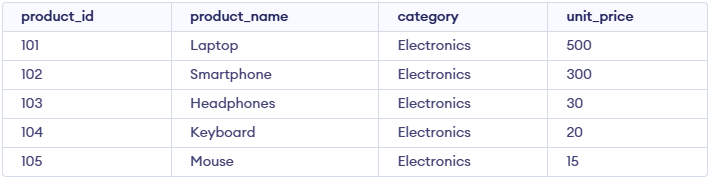
Now, compare each product name with 'Laptop':
SELECT product_name,STRCMP(product_name, 'Laptop') AS comparison_resultFROM products;
Output:
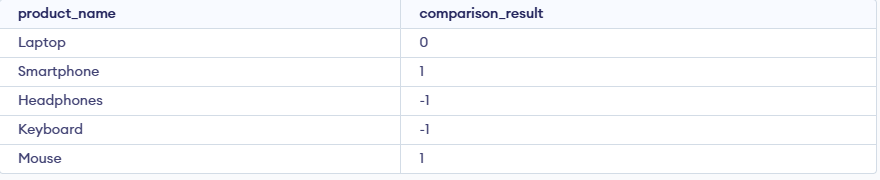
- The STRCMP() function compares each product_name with 'Laptop' and returns the comparison result.
