

Product-to-sum formulas are trigonometric identities that convert the product of two trigonometric functions into a sum or difference of trigonometric functions.
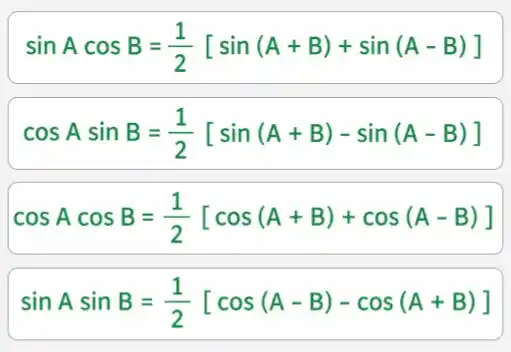
Formula Derivation
The product to sum formulae can be derived using the trigonometric sum/difference formulae.
The Sum/difference formulae are given below:
- sin(A+B) = sinA cosB + cosA sinB ———— (1)
- sin(A−B) = sinA cosB − cosA sinB———— (2)
- cos(A+B) = cosA cosB − sinA sinB———— (3)
- cos(A−B) = cosA cosB + sinA sinB———— (4)
cos A cos B Formula (Product of Cosines)
To derive the cos A cos B formula add equations (3) and (4)
⇒ cos (A + B) + cos (A – B) = [cos A cos B – sin A sin B] + [cos A cos B + sin A sin B]
⇒ cos (A + B) + cos (A – B) = cos A cos B + cos A cos B
⇒ cos (A + B) + cos (A – B) = 2 cos A cos B
Hence,
cos A cos B = (½) [cos (A + B) + cos (A – B)]
cos A sin B Formula (Product of Sine and Cosine)
To derive the cos A sin B formula subtract equations (2) from (1)
⇒ sin (A + B) – sin (A – B) = [sin A cos B + cos A sin B] – [sin A cos B – cos A sin B]
⇒ sin (A + B) – sin (A – B) = sin A cos B + cos A sin B – sin A cos B + cos A sin B
⇒ sin (A + B) – sin (A – B) = 2 cos A sin B
Hence,
cos A sin B = (½) [sin (A + B) - sin (A - B)]
sin A cos B Formula (Product of Sine and Cosine)
To derive the sin A cos B formula add equations (1) and (2)
⇒ sin (A + B) + sin (A – B) = [sin A cos B + cos A sin B] + [sin A cos B – cos A sin B]
⇒ sin (A + B) + sin (A – B) = sin A cos B + sin A cos B
⇒ sin (A + B) + sin (A – B) = 2 sin A cos B
Hence,
sin A cos B = (½) [sin (A + B) + sin (A - B)]
sin A sin B Formula (Product of Sines)
To derive the sin A sin B formula subtract equations (4) from (3)
⇒ cos (A – B) – cos (A + B) = [cos A cos B + sin A sin B] – [cos A cos B – sin A sin B]
⇒ cos (A – B) – cos (A + B) = cos A cos B + sin A sin B – cos A cos B + sin A sin B
⇒ cos (A – B) – cos (A + B) = 2 sin A sin B
Hence,
sin A sin B = (½) [cos (A - B) - cos (A + B)]
Sample Problems
Problem 1: Express 6 cos 8x sin 5x as sum/difference.
Solution:
From one of the product to sum formulas, we have
cos A sin B = (½) [sin (A + B) - sin (A - B)]
So, by substituting A = 8x and B = 5x in the above formula, we get
cos 8x sin 5x = (½) [ sin (8x + 5x) - sin (8x - 5x) ]
cos 8x sin 5x = (½) [sin 13x - sin 3x]
Now, 6 cos 8x sin 5x = 6 × (½) [sin 13x - sin 3x]
Hence, 6 cos 8x sin 5x = 3 [sin 13x - sin 3x]
Problem 2: Determine the value of the integral of cos 4x cos 6x.
Solution:
From one of the product to sum formulas, we have
cos A cos B = (½) [cos (A + B) + cos (A - B)]
cos 4x cos 6x = ½ [cos (4x + 6x) + cos (4x - 6x)]
= (½) [cos 10x + cos (-2x)]
= (½) [cos 10x + cos 2x] {Since, cos (-θ) = cos θ}
Now, integral of cos 4x cos 6x = ∫ cos 4x cos 6x dx
= ∫(½) [cos 10x + cos 2x] dx
= 1/20 sin(10x) + 41sin(2x) + C
Answer : ∫cos4x cos6xdx = 1/20 sin(10x) + 1/4sin(2x) + C
Problem 3: Determine the value of sin 36° cos 54° without evaluating the sin 36° and cos 54° values.
Solution:
sin36 cos54 = 1/2 [sin90 + sin(−18)]
=1/2 [1−sin18]
If an exact numerical answer is required, use:
\frac{1}{2}\left[1-\frac{\sqrt{5}-1}{4}\right] Final Answer:
\frac{5-\sqrt{5}}{8}
Problem 4: Determine the value of the derivative of 4 cos 3x sin 2x.
Solution:
From one of the product to sum formulas, we have
cos A sin B = (½) [sin (A + B) - sin (A - B)]
Now, 4 cos 3x sin 2x = 4 × (½) [sin (3x + 2x) - sin (3x - 2x)]
= 2 [sin 5x - sin x]
Now, derivative of 4 cos 3x sin 2x = d(4 cos 3x sin 2x)/dx
= d/dx(2[sin5x−sinx])
= 2 [5 cos 5x - cos x] {Since, d(sin ax)/dx = a cos ax}
Hence, derivative of 4 cos 3x sin 2x = 2 [5 cos 5x - cos x] .
Problem 5: Determine the value of sin 15° sin 45° without evaluating the sin 15° and sin 45° values.
Solution:
From one of the product to sum formulas, we have
sin A sin B = (½) [cos (A - B) - cos (A + B)]
Now, sin 15° sin 45° = (½)[cos (15° - 45°) - cos (15° + 45°)]
= (½) [cos (-30°) - cos (60° )]
= (½) [cos 30° - cos 60°] {Since, cos (-θ) = cos θ}
= (½) [√3/2 - 1/2] {Since, cos 30° = √3/2 and cos 60° = 1/2}
= (½) [(√3 -1)/2]
= (√3 -1)/4
Hence, sin 15° sin 45° = (√3 -1)/4.
Problem 6: Express 2 cos 9x cos 7x as sum/difference.
Solution:
From one of the product to sum formulas, we have
cos A cos B = (½) [cos (A + B) + cos (A - B)]
Now, 2 cos 9x cos 7x = 2 × (½) [cos (9x + 7x) + cos (9x - 7x)]
= [cos (16x) + cos (2x)]
Hence, 2 cos 9x cos 7x = [cos 16x + cos 2x]
