

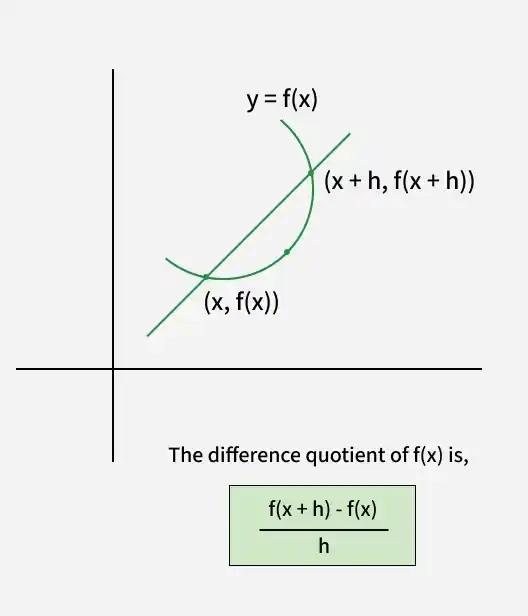
The difference quotient is a formula used to find the average rate of change of a function between two points. It also represents the slope of the secant line joining those points and is used to define the derivative of a function.
Formula
For a function f(x), the difference quotient is:
\frac{f(x+h)-f(x)}{h} where,
- f(x + h) is the value of the function at x + h.
- f(x) is the value of the function at x.
- h represents the change in x.
Difference Quotient Derivation
Consider a function y = f(x) and two points on its curve: (x, f(x)) and (x + h, f(x + h)). A secant line passing through these two points is shown in the figure.
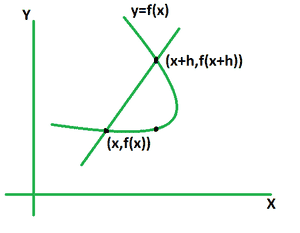
Using the slope formula: m = (y₂ - y₁) / (x₂ - x₁)
Substituting the coordinates of the two points:
m = [f(x + h) - f(x)] / [(x + h) - x]
Therefore: m = [f(x + h) - f(x)] / h
Thus, the difference quotient formula is:
[f(x + h) - f(x)] / h
As h approaches 0, the secant line approaches the tangent line to the curve. Therefore, the difference quotient gives the derivative of the function:
f'(x) = lim(h → 0) [f(x + h) - f(x)] / h
➢Practice: Solved Examples
