

A concave polygon is a type of polygon with at least one interior angle that is larger than 180°. In other words, a concave polygon has at least one "dent" or indentation in its boundary.
For example, stars can be represented as concave polygons because they appear as if two lines are pushed inwards while another line is pushed outwards. (In this example, the inward-pointing vertices refer to interior angles that exceed 180°).
Concave polygons can be categorized as:
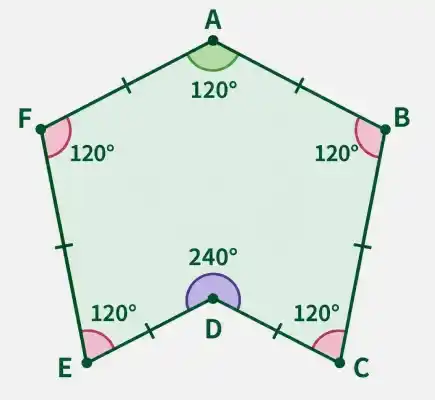
Regular Concave Polygon
A polygon is said to be regular when its side lengths and interior angles are both equal. Even any polygon must have at least one interior angle that will be more than 180 degrees; then only it's said to be a concave polygon. Moreover, the total of the interior angles of a polygon is equal to (n - 2) x 180, where "n" is the number of sides.
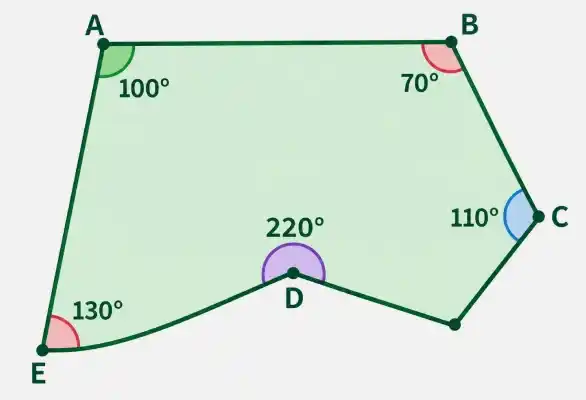
Irregular Concave Polygon
The irregular polygon's sides have various measurements of each interior angle that are not even congruent because the interior angles of concave polygons and their irregularity are commonly observed. Whereas, the measurements of the interior angles as well as the lengths of the sides of irregular concave polygons can fluctuate and give rise to a shape that lacks regular symmetry or pattern.
Angles in Concave Polygon
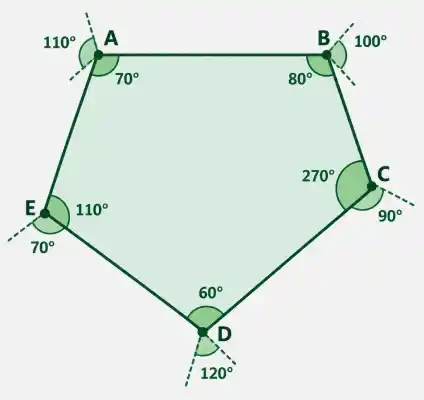
Like any 2D geometric object, polygons can have interior as well as exterior angles.
- Interior Angle: An interior angle is an angle formed between two adjacent sides of a polygon, measured inside the polygon.
- Exterior Angle: An exterior angle of a polygon is an angle formed between one side of the polygon and the extension of an adjacent side, measured outside the polygon.
Sum of Exterior Angles
In a polygon with n sides, each exterior angle corresponds to one interior angle. The sum of the exterior angles of any polygon, regardless of the number of sides, is always 360°.
Thus, for concave polygon sum of all exterior angle is 360°.
Sum of Interior Angles
The sum of the interior angles of a concave polygon can be found by using the same formula as (n-2) × 180°. Here "n" is the number of sides.
Example: Find the sum of the interior angles of a concave polygon with 7 sides.
Solution:
Given: n = 7
Sum of the Interior Angles = (n-2) × 180°
⇒ Sum of the Interior Angles = (7-2) × 180°
⇒ Sum of the Interior Angles = 5 × 180° = 900°
Formulas
Perimeter
The perimeter of a concave polygon is determined by the whole distance covered by their boundaries. Whereas, the length of each side of a given figure can be added together to determine its perimeter, i.e.,
Perimeter of Concave Polygon = Sum of all sides given in a figure
Area
The area of a concave polygon cannot be easily calculated, but it is possible for each side and each interior angle to have a decided length. Thus, we must divide the concave polygon into triangles, parallelograms, or other forms whose areas are simple to find out.
Area of Concave Polygon = Area of the different shapes that are given
Some other formulas related to concave polygons are
| Formula | Description |
|---|---|
| A = 1/2 × n × s | Area of a regular concave polygon, where A is the area, n is the number of sides, and s is the length of a side. |
| A = 1/2 × (n − 2) × s × h | Area of a concave polygon using side length and height, where A is the area, n is the number of sides, s is the length of a side, and h is the height. |
| A = 1/2 × n × r2 × sin(360°/n) | Area of a concave polygon using the radius of the circumscribed circle, where A is the area, n is the number of sides, r is the radius, and sin is the sine function. |
Concave vs Convex Polygons
The key differences between concave and convex polygons are listed in the following table:
| Feature | Concave Polygon | Convex Polygon |
|---|---|---|
| Definition | At least one interior angle is greater than 180 degrees. | All interior angles are less than 180°. |
| Shape | At least one part of the polygon "bulges" inward, creating a concavity. | No part of the polygon "bulges" inward. |
| Edges | Some edges point inward, toward the interior of the polygon. | All edges point outward, away from the interior of the polygon. |
| Convexity | Only portions of the polygon may be convex; overall, the polygon is concave. | The entire polygon is considered to be convex. |
| Properties | May have more complex geometrical properties due to concavities. | Typically simpler to analyze and work with. |
| Examples | Star polygons, irregular polygons with one or more indentations. | Regular polygons (e.g., equilateral triangle, square, pentagon). |
Properties
A concave polygon can be distinguished from other polygons by a few unique characteristics or properties.
- In this polygon, at least one angle must be the reflex angle, that is, more than 180° and less than 360°.
- In the shape of the polygon, there must be at least one vertex that seems to be pushed inwards.
- A line segment touches more than two sides of a concave polygon when it is drawn across it.
- These polygons can never be a regular polygon.
- Due to the various measurements of the inner angles, they are said to be irregular polygons.
