

A Graph Database is a type of NoSQL database that stores data as nodes, relationships (edges) and properties. It is designed to efficiently represent and query connected data.
- Designed to manage interconnected data.
- Uses Neo4j, Amazon Neptune and JanusGraph for graph processing.
- Stores relationships as edges for direct navigation between connected nodes.
Components of a Graph Database
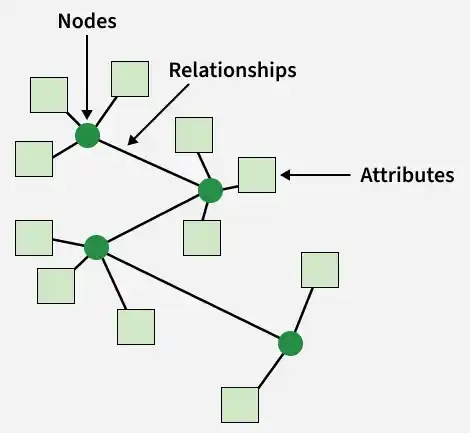
A graph database stores data as a collection of nodes and relationships instead of tables. The following are the main components of a graph database.
Nodes (Vertices)
Nodes represent entities or objects in the graph. Each node can store properties that describe the entity.
Examples:
- Person
- Customer
- Product
- City
Example
(Person: John)Relationships (Edges)
Relationships connect two nodes and represent how they are related. They define the connections between entities.
Examples:
- FRIENDS_WITH
- PURCHASED
- WORKS_FOR
- LOCATED_IN
Example
(John)-[:FRIENDS_WITH]->(Alice)Properties
Properties are key-value pairs that store additional information about nodes and relationships.
Examples:
- Name = "John"
- Age = 25
- Since = 2022
Example:
(Person {Name: "John", Age: 25})Labels
Labels categorize nodes into different groups, making it easier to organize and query data.
Examples:
- Person
- Employee
- Customer
- Product
A node can have one or more labels.
Relationship Types
Relationship types define the meaning of the connection between two nodes.
Examples:
- FRIENDS_WITH
- WORKS_FOR
- PURCHASED
- MANAGES
Using relationship types makes graph traversal more efficient.
Example of Graph Database
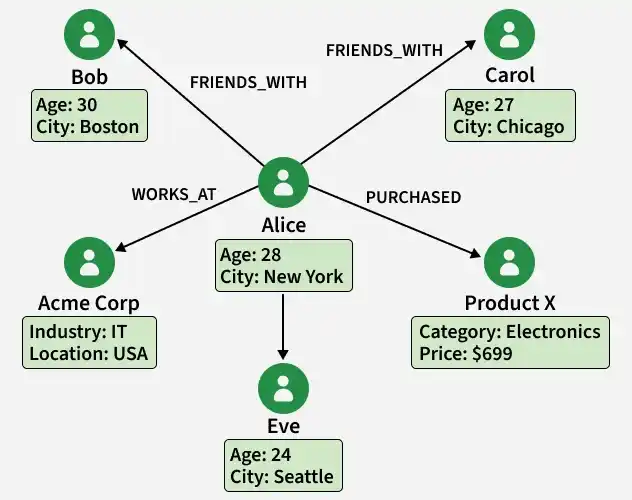
The following graph shows how entities are connected through relationships and enriched with properties in a graph database.
Step 1: Identify the Nodes
Nodes represent the entities in the graph.
In the diagram:
- Alice
- Bob
- Carol
- Eve
- Acme Corp
- Product X
These are all nodes because they represent people, an organization and a product.
Step 2: Identify the Relationships
Relationships connect nodes and describe how they are associated.
In the diagram:
- Alice → FRIENDS_WITH → Bob
- Alice → FRIENDS_WITH → Carol
- Alice → WORKS_AT → Acme Corp
- Alice → PURCHASED → Product X
These relationships directly connect related entities.
Step 3: Identify the Properties
Properties store additional information about nodes.
In the diagram:
- Alice: Age = 28, City = New York
- Bob: Age = 30, City = Boston
- Carol: Age = 27, City = Chicago
- Eve: Age = 24, City = Seattle
- Acme Corp: Industry = IT, Location = USA
- Product X: Category = Electronics, Price = $699
Step 4: Traverse the Graph
When a query is executed, the graph database follows relationships directly to retrieve connected data instead of performing JOIN operations.
Example:
- To find Alice's friends, the database follows the FRIENDS_WITH relationships and returns Bob and Carol.
- To find where Alice works, it follows the WORKS_AT relationship and returns Acme Corp.
- To find what Alice purchased, it follows the PURCHASED relationship and returns Product X.
Uses of Graph Databases
Graph databases are widely used in applications where relationships between data are important.
- Social Networks: Manage user connections and friendships.
- Recommendation Systems: Suggest products, movies or friends based on user preferences.
- Fraud Detection: Detect suspicious connections and fraudulent activities.
- Knowledge Graphs: Organize connected information for better search and analysis.
Advantages of Graph Databases
- High Performance: Provides fast query execution for relationship-based and connected data.
- Efficient for Connected Data: Handles complex relationships effectively, making it ideal for networked data.
- Flexible Data Model: Allows easy addition of new nodes and relationships without changing the schema.
Limitation of Graph Databases
- Database-Specific Query Languages: Many graph databases use proprietary query languages, reducing portability.
- Not Suitable for Transaction-Heavy Applications: Less efficient for applications with a large number of simple transactions.
- Requires Specialized Knowledge: Developers need to understand graph concepts and traversal techniques.
