

SRAM and DRAM are two types of Random Access Memory (RAM) used in computer systems. Both are volatile memories, meaning they lose stored data when the power is turned off, but they differ in how data is stored and maintained.
- SRAM stores each bit using a group of transistors and does not require periodic refreshing. It is faster and is commonly used for cache memory.
- DRAM stores each bit using a transistor and capacitor and requires periodic refreshing to retain data. It is slower than SRAM but provides higher memory density at a lower cost per bit and is commonly used as main memory.
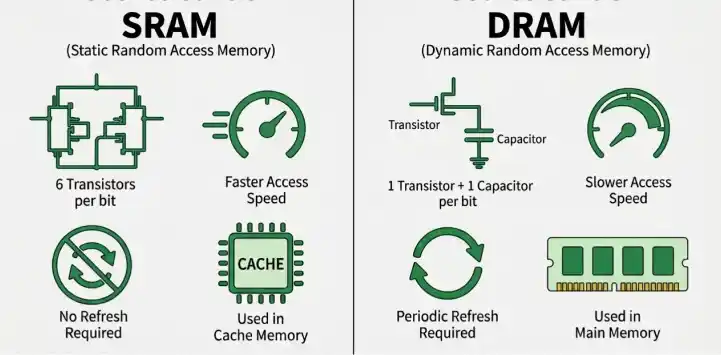
The table below shows the major differences between SRAM and DRAM:
| SRAM | DRAM |
|---|---|
| Data is stored using a group of transistors. | Data is stored using a transistor and a capacitor. |
| Does not require periodic refreshing. | Requires periodic refreshing to retain data. |
| Provides faster access to data. | Provides slower access compared to SRAM. |
| Has a more complex memory cell design. | Has a simpler memory cell design. |
| Requires more chip area per bit. | Requires less chip area per bit. |
| Has lower memory density. | Has higher memory density. |
| More expensive per bit. | Less expensive per bit. |
| Commonly used for CPU cache memory. | Commonly used for main memory. |
| Used where high-speed data access is required. | Used where high-capacity memory is required. |
Advantages of SRAM
- Faster access speed than DRAM.
- Does not require periodic refreshing, reducing refresh overhead.
- Lower latency, making it suitable for high-speed memory applications.
Disadvantages of SRAM
- Higher cost per bit than DRAM.
- Lower memory density, making it less suitable for large-capacity memory.
- Requires more chip area per bit because its memory cell uses multiple transistors.
Advantages of DRAM
- Higher memory density, allowing larger memory capacities.
- Lower cost per bit than SRAM.
- Requires less chip area per bit, making it suitable for high-capacity memory systems.
Disadvantages of DRAM
- Slower access speed than SRAM.
- Requires periodic refreshing to retain stored data.
- Refresh operations add overhead to the memory system.
