

Key Takeaways
- An AI database is a system that can store and query the data models modern AI workloads actually need: relational, JSON/document, vector, graph, text, and spatial, under shared architectural guarantees.
- “Multi-model” describes what a product can store. “Converged” describes the guarantees that span those models: one transaction boundary, one optimizer, one consistency model, one security/governance domain, and shared access surfaces.
- For RAG and agent workloads, convergence matters because retrieval must stay fresh, governed, and joinable with operational data.
- Specialized vector databases are strong choices for pure similarity search and vector-serving workloads. When RAG or agents also need fresh operational data, transactions, and unified access control, those requirements may need to be coordinated at the application level.
- Oracle AI Database 26ai is used here as a concrete, publicly testable example of the five convergence tests, not as the definition itself.
Introduction
Modern AI applications rarely rely on a single data type. RAG needs embeddings, while agents need conversation history, tool results, and durable facts, alongside live business data such as orders, policies, inventory, and customer records under the same access rules.
A common approach is to stitch together specialized stores: vector databases for similarity search, document stores for flexible data, relational databases for transactions, and search engines for keyword lookup. While this can work for demos, production systems introduce four common problems:
- Stale embeddings: Vector indexes can lag behind changes in operational data.
- Eventual-consistency windows: Updates may not reach every store at the same time.
- Fragmented access controls: Separate permission models can expose data to unauthorized users.
- Synchronization pipelines: ETL, change streams, and reindexing add ongoing operational overhead.
The result can be answers that are locally fluent and globally wrong for example, when RAG uses yesterday’s embeddings while today’s order status lives elsewhere.
The architectural question is not simply “which store holds vectors?” but what properties must a database provide so AI workloads can retrieve, join, and act on data without rebuilding consistency and governance at the application layer?
This article answers that question with a neutral definition of an AI database and five practical tests developers can run themselves. Oracle AI Database 26ai serves as a concrete, publicly testable example. For the original definition and framework, see the Oracle Developers article, What Is a Converged Database? Definition, Five Tests, and AI Use Cases.
What “AI Database” Actually Means
An AI database is a database designed so that the data models required by modern AI applications like relational tables, JSON documents, vector embeddings, graphs, text, and spatial data can be stored, queried, and governed together.
That definition is deliberately architectural rather than product-specific. It does not require a particular vendor. It does require that the system can participate in AI workloads without forcing the application to become the integration layer between separate engines.
Three patterns are often confused:
| Pattern | What it means | Implication for AI workloads |
|---|---|---|
| Converged database | One engine supports multiple data models under shared transaction, optimizer, consistency, and governance guarantees. | Useful when RAG or agents need retrieval that is fresh, governed, and joined with operational context. |
| Multi-model database | One product can store several models, but the guarantees may stop at model boundaries. | Useful for consolidation. When cross-model queries, rollback, or access control must behave as one system, those guarantees typically need to be coordinated at the application layer. |
| Specialized vector database | A system optimized for embedding similarity search. | A strong fit for pure similarity-serving and high-throughput vector workloads. When the application also needs live relational predicates, transactions, or cross-model joins under one governance model, those capabilities typically live outside the vector store and must be coordinated by the application. |
- Multi-model is a storage claim. Converged is a guarantees claim. Most popular databases now advertise multi-model support.
- Far fewer demonstrate that a single ACID transaction, a single costed plan, and a single security domain span those models.
The Five Tests of a Converged Database
“Supports multiple models” is a property of the storage layer. Convergence is a property of the architecture. Five testable criteria separate multi-model storage from converged guarantees.
1. One transaction boundary
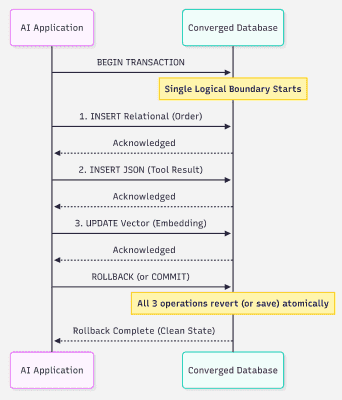
A single ACID transaction can span a relational insert, a document write, a vector update, and the indexes that serve them, and a rollback reverts all of it atomically.
Why it matters for AI:
- When an agent records a tool result, updates a preference memory, and writes an embedding in the same logical operation, partial failure should not leave the system in an inconsistent state.
- Across separate specialized stores, that coordination becomes application-level compensation code.
2. One optimizer
A cost-based planner can produce a single costed plan for supported cross-model statements, for example, statements that combine relational joins, JSON predicates, graph patterns (SQL/PGQ), and vector distance ranking. Where the engine supports the combination, EXPLAIN PLAN shows one plan tree rather than an application-side fan-out across services.
Why it matters for AI:
- Hybrid retrieval often combines vector distance, keyword predicates, JSON filters, and relational joins.
- When the optimizer sees the whole statement, it can reorder and push down predicates.
- When each model lives behind its own service, the application owns the join order and the latency budget.
3. One consistency model
Read-your-writes holds across the supported models and APIs because no inter-model replication pipeline sits between them: no change-stream lag, no reindex delay, no eventual-consistency window between an operational row and its embedding inside the same engine.
Why it matters for AI:
- An agent that just updated a customer preference should be able to retrieve that preference on the next turn without waiting for a secondary index to catch up.
- RAG that answers from yesterday’s embeddings while today’s order status lives in another store produces answers that are locally fluent and globally wrong.
4. One security and governance domain
The same privilege model, row-level security/policy mechanisms, and audit capabilities can cover the SQL interface, document API, vector search path, and graph access, because each is a projection of the same engine over the same underlying data. Exact coverage depends on how privileges, policies, and auditing are configured for each access path.
Why it matters for AI:
- Permission filters must apply before generation.
- If vector chunks, JSON documents, and relational rows each carry their own ACL model, the application becomes the policy enforcement point, and every new agent or tool is another place that policy can be forgotten.
5. Shared access surfaces
SQL, the Oracle Database API for MongoDB, and Oracle REST Data Services (ORDS) operate on the same data as projections of one engine. In addition, Oracle AI Database 26ai exposes natural-language access through Select AI, so the same governed data can be queried in plain language under the same security model.
Why it matters for AI:
- Developers and agents need the surface that fits the task: SQL for precise joins and governance, document APIs for flexible payloads, REST for integration, without inventing a second source of truth.
Taken together, the five tests restate a simple rule: converged = multi-model + the guarantees that span the models.
Why These Guarantees Matter for AI Workloads
RAG and agent systems become harder to govern when operational data, documents, and embeddings live in separate stores. A converged approach can keep these data types under shared transaction, consistency, and governance guarantees, reducing the synchronization and access-control work required at the application layer.
A Concrete Example: One Governed Answer Across Models
Consider a support agent answering:
“What is the status of my recent order and the current return policy that applies to it?”
In a converged setup, the same engine can hold:
- Relational data: Orders and order_items with live status, customer IDs, and amounts.
- JSON/document data: Return-policy or product documents with flexible metadata.
- Vector data: Embeddings over policy and help content for semantic retrieval using Oracle AI Vector Search.
A single request can then:
- Authenticate the user and establish the appropriate tenant or user scope.
- Retrieve the relevant order using relational predicates and row-level security.
- Retrieve the applicable policy document or semantically closest policy content (vector / hybrid search).
- Join or filter the results under the same privilege and audit model.
- Generate one answer that combines current operational data with the retrieved policy evidence.
Because these models can share transaction, consistency, and governance guarantees, the application can avoid maintaining separate synchronization between the order status and policy data while keeping access controls within the same governance model.
The five tests are therefore not abstract architectural ideas; they determine whether an AI system can produce an answer that is fresh, governed, and joinable in one place.
Oracle AI Database 26ai as a Worked Example
Oracle AI Database 26ai is one concrete implementation that satisfies the five tests above. The tests themselves remain product-agnostic; the product is useful here because the claims are publicly reproducible.
In practice, the mapping looks like this:
Transaction boundary — relational, JSON, and Oracle AI Vector Search support vector data within the same database transaction.
-- Illustrative: one ACID transaction spanning relational, JSON, and vector
-- Try on Oracle AI Database Free / FreeSQL. Full lab scripts in the companion repository.

INSERT INTO orders (customer_id, store_id, status, total_amount)
VALUES (1, 1, 'placed', 99.99);

INSERT INTO order_items (order_id, line_no, product_id, qty, unit_price)
VALUES ((SELECT MAX(order_id) FROM orders), 1, 1, 1, 99.99);

INSERT INTO events (data)
VALUES (JSON('{"type":"order_placed","channel":"lab","note":"document write, same txn"}'));

UPDATE support_tickets
   SET status = 'pending',
       embedding = TO_VECTOR('[0.5,0.5,0.5,0.5,0.5,0.5,0.5,0.5]', 8, FLOAT32)
 WHERE ticket_id = 1;

-- COMMIT;   -- all four changes become visible together
-- ROLLBACK; -- all four changes disappear together
Note: Example shape from the public converged-database lab. Vector dimension and table names are simplified for illustration; use the lab scripts for the exact runnable schema.
Optimizer — cross-model statements (including graph patterns via SQL/PGQ, JSON operators, and vector distance) can be planned as a single costed tree.
-- Illustrative cross-model shape: relational + graph + JSON in one statement
-- (SQL/PGQ GRAPH_TABLE + JSON_TABLE). See lab for full schema and assertions.

SELECT DISTINCT jt.product_no
FROM GRAPH_TABLE (smm_social
        MATCH (c IS smm_customers) -[IS smm_knows]-> (f IS smm_customers)
        WHERE c.credit_limit > 3000
        COLUMNS (f.customer_id AS friend_id)) g
JOIN smm_orders o ON o.customer_id = g.friend_id
CROSS JOIN JSON_TABLE (o.doc, '$.Orderlines[*]'
        COLUMNS (product_no VARCHAR2(16) PATH '$.Product_no')) jt;
Note: Pattern taken from the public multi-model challenge recreation in the Oracle lab. Requires the lab schema (customers, knows graph, orders as JSON).
Consistency — no inter-model replication lag inside the engine; read-your-writes holds across the supported APIs.
-- Agent records a new preference during a chat
UPDATE agent_memory
SET context_vector = VECTOR_EMBEDDING(doc_model USING 'User prefers standard shipping')
WHERE session_id = 'A123';
COMMIT;

-- Immediate next turn: Semantic search instantly reflects the exact update
SELECT memory_text
FROM agent_memory
ORDER BY VECTOR_DISTANCE(context_vector, VECTOR_EMBEDDING(doc_model USING 'shipping preference'), COSINE)
FETCH FIRST 1 ROW ONLY;
Governance — the same privilege, row-level, and audit mechanisms apply across SQL, document, and vector access paths.
-- Create a single tenant isolation policy
BEGIN
  DBMS_RLS.ADD_POLICY(
    object_schema  => 'app_user',
    object_name    => 'customer_profiles',
    policy_name    => 'tenant_isolation_policy',
    function_schema => 'sec_admin',
    policy_function => 'get_tenant_predicate'
  );
END;
/

-- Result: Any subsequent Vector Search, JSON API call, or SQL query will implicitly only return embeddings the active user has the explicit right to see.
Result: Any subsequent Oracle AI Vector Search, Oracle Database API for MongoDB call, or SQL query will implicitly only return embeddings the active user has the explicit right to see.
Shared surfaces — SQL, Oracle Database API for MongoDB, and Oracle REST Data Services (ORDS) project the same underlying data.
-- Data Scientist using SQL to analyze agent logs:
SELECT JSON_VALUE(payload, '$.result') AS result
FROM agent_logs
WHERE log_id = 99;
Bash:
# Web Developer using a REST endpoint (ORDS) to fetch the exact same JSON document:
curl -X GET "https://<your-database-url>/ords/app_user/agent_logs/99"
Public companion material (including the converged-database lab scripts and the Oracle AI Developer Hub). Free local containers and FreeSQL paths exist for hands-on exploration without a production commitment.
When a Converged Approach Helps (and When It May Not)
A converged design is most useful when the application needs more than one data model and needs strong guarantees across those models, fresh retrieval joined to live predicates, agent memory that stays consistent with operational tables, or hybrid search under a single security policy.
It can be overkill for:
- Pure similarity-serving workloads that never join back to transactional data.
- Simple embedded or single-model applications with no cross-model consistency requirements.
- Prototypes where operational simplicity of a specialized store outweighs long-term integration cost.
The decision is workload-driven. Convergence is an architectural property to evaluate, not a universal requirement.
Conclusion
An AI database is defined by what it lets you do under shared guarantees, not by a marketing label. Multi-model storage is now common. Convergence one transaction boundary, one optimizer, one consistency model, one governance domain, and shared access surfaces is the stricter and more useful test for RAG and agent workloads that must stay fresh, governed, and joinable with operational data.
- Oracle AI Database 26ai is one concrete system that meets those tests.
- The tests themselves are architectural and product-agnostic.
- The companion Oracle Developers article owns the formal definition and framework; this piece focuses on how developers can reason about and evaluate those guarantees in practice.
Try it yourself
- Run the five tests against a live instance using Oracle AI Database Free or FreeSQL and the public lab scripts linked above. That is the fastest way to move from definition to evidence.
- In the next article we look at the practical mechanics of storing and searching vector embeddings inside such a database, including the intended index and query paths developers should use.
Most Asked Questions
What is the difference between an AI database and a vector database?
A vector database is optimized for embedding similarity search. An AI database is broader: it is expected to support the mix of models AI applications actually use (including vectors) under shared transactional, consistency, and governance guarantees.
Is every multi-model database a converged database?
No. Multi-model means the product can store several models. Converged means the architectural guarantees, transactions, optimizer, consistency, security, and access surfaces span those models.
Why do transaction and governance boundaries matter for RAG?
Because retrieval that is stale or unauthorized produces answers that look fluent and are still wrong. When embeddings and operational rows share one transaction and one security domain, freshness and permission become properties of the data layer rather than application glue.
Can I start with a free tier to test these ideas?
Yes. Oracle AI Database Free / FreeSQL provide low-friction paths to experiment with the patterns described here. Always Free Autonomous AI Database options exist for managed cloud experiments.
How does this relate to agent memory and tool calling?
Agent memory is durable state (history, facts, tool results) that must remain scoped and consistent. Tool calling is how agents act. Both become simpler when memory, operational data, and retrieval live under the same guarantees. Later articles in this series cover the agent loop, RAG versus agent memory, and hands-on memory systems in more detail.
Resources
- What Is a Converged Database? Definition, Five Tests, and AI Use Cases
- Converged Database vs. Multi-Model Database: What’s the Difference?
- 5 Oracle AI Database Dev Tools I’d Put in a Starter Kit
- Oracle AI Vector Search documentation
- JSON Relational Duality
- SQL/PGQ (Property Graph Queries)
- Oracle Database API for MongoDB
- Oracle REST Data Services (ORDS)
- Select AI overview
- Oracle AI Developer Hub
- Oracle AI Database Free / FreeSQL starter paths
Latest Release
