

Instruction tuning is a fine-tuning approach that trains a pre-trained language model on instruction-response pairs so it can better understand and follow natural language instructions.
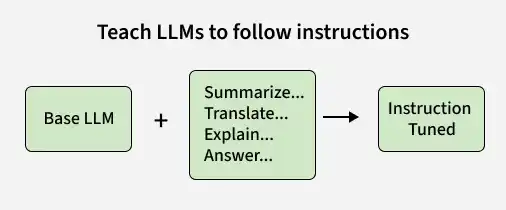
It uses examples from tasks such as question answering, summarization, translation, classification and code generation. By learning from diverse, high-quality examples, instruction tuning helps models follow instructions better, generalize across tasks and generate responses that match user intent.
Working
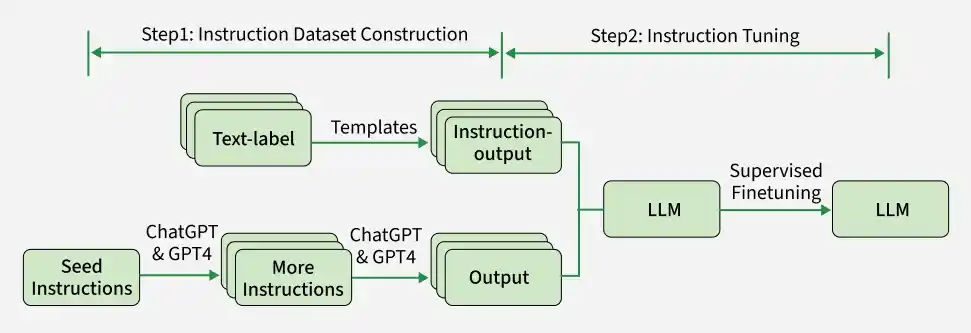
Step 1: Prepare Instruction-Response Data
Instruction-tuning data consists of examples containing a natural language instruction and its desired response.
Example:
- Instruction: "Translate the following sentence into French: Hello, how are you?"
- Response: "Bonjour, comment allez-vous ?"
Common tasks include question answering, summarization, translation, classification, text generation and code generation.
Step 2: Fine-Tune the Model
The pre-trained language model is fine-tuned on these instruction-response examples using supervised learning. The model learns to predict appropriate responses based on the given instructions.
Step 3: Evaluate the Model
The fine-tuned model is evaluated on held-out examples to measure how accurately it follows instructions and performs across different tasks. The training data or fine-tuning process can then be refined based on the evaluation results.
Characteristics of Datasets
A good instruction-tuning dataset generally has the following characteristics:
- Instruction-Response Pairs: Each example contains an instruction describing the task and a corresponding desired response.
- Task Diversity: Examples cover different tasks, such as question answering, summarization, translation and code generation.
- Natural Language Instructions: Instructions are written in natural language so the model learns to interpret task descriptions similar to real user requests.
- High-Quality Responses: Responses should be accurate, relevant and appropriately formatted because the model learns from these examples.
Examples of Datasets and Methods
1. FLAN
FLAN (Fine-tuned LAnguage Net) refers to a family of instruction-tuning work and datasets from Google Research. The FLAN Collection combines a large number of tasks and datasets expressed through natural language instructions to improve a model's ability to generalize across tasks.
2. Super-Natural Instructions
Super-Natural Instructions is a large benchmark and instruction dataset containing diverse tasks described using natural language instructions. It includes tasks such as classification, question answering, text generation and reasoning, helping models learn to follow a wide variety of instructions.
3. Alpaca
Alpaca is an instruction-following dataset released by researchers at Stanford. It contains 52,000 instruction-following examples generated using OpenAI's text-davinci-003 model and was used to fine-tune a smaller language model for instruction following.
4. OpenAssistant
OpenAssistant is an open-source, crowdsourced dataset containing human-generated assistant conversations. It includes instruction-response and conversational examples for training models to interact with users.
5. Self-Instruct
Self-Instruct is a method for generating instruction-tuning data using a language model. The model generates new instructions and corresponding outputs, which can then be filtered and used to create a larger instruction-tuning dataset with less manual annotation.
Applications
- Question Answering: Following questions and providing relevant answers.
- Content Generation: Generating articles, summaries, reports or other content according to given requirements.
- Code Generation: Producing or explaining code based on natural language instructions.
- Customer Support: Powering conversational systems that interpret user queries and provide appropriate responses.
- Text Transformation: Performing tasks such as translation, summarization, rewriting and classification.
Challenges
- Data Quality: Low-quality, incorrect or ambiguous examples can teach the model undesirable behaviors.
- Data Diversity: A dataset that covers only a narrow range of tasks may limit the model's ability to generalize to new instructions.
- Overfitting: Excessive fine-tuning on a limited dataset can reduce performance on tasks outside the training distribution.
- Bias: Instruction-tuning data can contain biases that may be learned by the model.
- Computational Cost: Preparing large datasets and fine-tuning large language models can require significant computational resources.
Instruction Tuning vs. Multi-Task Fine-Tuning
| Instruction Tuning | Multi-Task Fine-Tuning |
|---|---|
| Focuses on following natural language instructions across diverse tasks. | Focuses on improving performance across multiple predefined tasks. |
| Uses instruction-response examples that resemble how users naturally specify tasks. | Uses datasets associated with different tasks, often with task-specific objectives or formats. |
| Emphasizes flexibility and generalization to different instructions. | Emphasizes learning multiple task-specific capabilities together. |
| Can include many different tasks in a unified instruction-based format. | Combines multiple datasets or objectives during training. |
Note: The two approaches can overlap. Instruction tuning can itself be performed as a form of multi-task fine-tuning when the instruction dataset contains multiple tasks.
