Navigating Price Fluctuations 📈 - A Physicist's Perspective on the Presidential Election Dynamics

Have you ever watched 🧐 the markets shift dramatically and wondered what’s really driving those fluctuations?
As the election approaches, markets often experience significant volatility that can seem sudden and dramatic. A recent surge of three yen in just a few hours on U.S. presidential election day has sparked my curiosity about the underlying dynamics of such price movements. 📈

Right Pannel : Spot Price from Pocket Tradom (ポケットトレーダム) app.
Both snapshots are captured at the same moment.
Could this phenomenon be linked to concepts of phase transitions, critical points, and the latent heat associated with them? 🤔
Phase Transition and Market Fluctuation :
In Physics, a phase transition occurs when a system changes from one state to another, such as from liquid to gas. This concept can be applied to finance, where we might observe a sudden shift in market behaviour. For example, a shift from a rising market to one with falling prices can resemble these physical changes. Such transitions are often triggered by factors like changes in investor sentiment, economic indicators, or external shocks, similar to how temperature changes can cause ice to melt or water to boil.
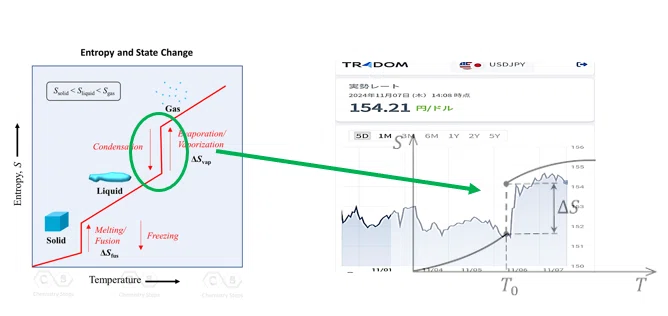
Right: Lecture Notes of Willkommen am Institut für Theoretische Physik (Chapter 6)
Image compares the two scenarios discussed above.
Entropy is the measure of uncertainty. As uncertainty around the election mounts, market volatility can increase, reflecting a rise in entropy. Just like a thermodynamic system that becomes more disordered when heat is added, the stock market can become chaotic in the face of unpredictable events.
Critical Points and Market Instability :
In Physics, a critical point is a specific condition (often defined by temperature and pressure) at which a substance undergoes a dramatic change in state (as discussed above). For example, consider water transitioning to steam. At 100 degrees Celsius (at standard atmospheric pressure), a small increase in temperature can cause water to rapidly boil. This is a phase transition where the properties of the substance change dramatically: the orderly structure of liquid water breaks down into the chaotic state of steam.
As a newcomer to finance, I can see the sudden rise of 3 yen over a few hours as a dramatic change, akin to a critical point in physics. In this case, the critical condition driving this fluctuation was the vote counts between two candidates. At these critical junctures, small changes in underlying conditions like a surprising economic report or unexpected election results—can lead to disproportionately large effects. This phenomenon reflects the interconnectedness of market participants, where the actions of a few can amplify fluctuations throughout the entire system.
Latent Heat - The Build-Up of Market Tension :
In Physics, latent heat refers to the energy absorbed or released during a phase transition without a change in temperature. Similarly, in financial markets, periods of relative stability can accumulate tension or risk. This latent "energy" represents accumulated investor sentiment, which can trigger abrupt market movements once a certain threshold is reached. During election cycles, the uncertainty surrounding potential outcomes can create a buildup of this latent risk.
How Do Political Events Influence Financial Markets?
In hydrodynamics, the movement of fluids is driven by pressure differentials (ΔP), much like how capital flows in financial markets. Imagine a river where water flows from high-pressure areas to low-pressure areas, creating currents and eddies. Similarly, stock prices can reflect fluid dynamics in action. When investor sentiment shifts—perhaps due to election news or economic reports—the "pressure" in the market changes, causing prices to rise or fall rapidly. Just as water seeks lower pressure, capital flows toward assets perceived as more valuable based on current information. Political events create a buildup of sentiment—an invisible pressure that can dramatically shift once results are announced. This anticipation influences investor behavior, sending ripples through global markets as money moves toward currencies and assets deemed more favorable in light of the outcomes.
Insights to Market Dynamics Through Physics :
In my view, the analogy of phase transitions in physics, alongside concepts from hydrodynamics, provides valuable insights into financial markets, particularly during key events like presidential elections. Just as materials change states under specific conditions, and as fluids flow from areas of high pressure to low pressure, market sentiment acts as a crucial latent factor in financial dynamics. This sentiment can shift dramatically, leading to sudden fluctuations. Significant gains for investors can indicate that market makers—who provide liquidity—have incurred losses, highlighting how their strategies influence market "phase transitions" and create pressure differentials that drive capital flows.
By examining these concepts, we can deepen our understanding of market behavior during pivotal moments. Whether you’re an experienced investor or simply curious, I believe that applying principles from physics and hydrodynamics can illuminate the dramatic price changes we observe, revealing the interconnectedness of events and sentiments within the financial landscape.
Given the complexities and interconnectedness of financial markets, especially during significant events, what are your thoughts on how we can better anticipate and navigate these sudden shifts in sentiment? I'd love to hear your insights!