


Interatomic potential

Interatomic potentials are mathematical functions to calculate the potential energy of a system of atoms with given positions in space.[1][2][3][4] Interatomic potentials are widely used as the physical basis of molecular mechanics and molecular dynamics simulations in computational chemistry, computational physics and computational materials science to explain and predict materials properties. Examples of quantitative properties and qualitative phenomena that are explored with interatomic potentials include lattice parameters, surface energies, interfacial energies, adsorption, cohesion, thermal expansion, and elastic and plastic material behavior, as well as chemical reactions.[5][6][7][8][9][10][11]
Functional form
[edit]Interatomic potentials can be written as a series expansion of functional terms that depend on the position of one, two, three, etc. atoms at a time. Then the total potential of the system can be written as [3]


Here is the one-body term, the two-body term, the three body term, the number of atoms in the system, the position of atom , etc. , and are indices that loop over atom positions.


Note that in case the pair potential is given per atom pair, in the two-body term the potential should be multiplied by 1/2 as otherwise each bond is counted twice, and similarly the three-body term by 1/6.[3] Alternatively, the summation of the pair term can be restricted to cases and similarly for the three-body term , if the potential form is such that it is symmetric with respect to exchange of the and indices (this may not be the case for potentials for multielemental systems).


The one-body term is only meaningful if the atoms are in an external field (e.g. an electric field). In the absence of external fields, the potential should not depend on the absolute position of atoms, but only on the relative positions. This means that the functional form can be rewritten as a function of interatomic distances and angles between the bonds (vectors to neighbours) . Then, in the absence of external forces, the general form becomes



In the three-body term the interatomic distance is not needed since the three terms are sufficient to give the relative positions of three atoms in three-dimensional space. Any terms of order higher than 2 are also called many-body potentials. In some interatomic potentials the many-body interactions are embedded into the terms of a pair potential (see discussion on EAM-like and bond order potentials below).


In principle the sums in the expressions run over all atoms. However, if the range of the interatomic potential is finite, i.e. the potentials above some cutoff distance , the summing can be restricted to atoms within the cutoff distance of each other. By also using a cellular method for finding the neighbours,[1] the MD algorithm can be an O(N) algorithm. Potentials with an infinite range can be summed up efficiently by Ewald summation and its further developments.


Force calculation
[edit]The forces acting between atoms can be obtained by differentiation of the total energy with respect to atom positions. That is, to get the force on atom one should take the three-dimensional derivative (gradient) of the potential with respect to the position of atom :

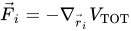
For two-body potentials this gradient reduces, thanks to the symmetry with respect to in the potential form, to straightforward differentiation with respect to the interatomic distances . However, for many-body potentials (three-body, four-body, etc.) the differentiation becomes considerably more complex [12] [13] since the potential may not be any longer symmetric with respect to exchange. In other words, also the energy of atoms that are not direct neighbours of can depend on the position because of angular and other many-body terms, and hence contribute to the gradient .


Classes of interatomic potentials
[edit]Interatomic potentials come in many different varieties, with different physical motivations. Even for single well-known elements such as silicon, a wide variety of potentials quite different in functional form and motivation have been developed.[14] The true interatomic interactions are quantum mechanical in nature, and there is no known way in which the true interactions described by the Schrödinger equation or Dirac equation for all electrons and nuclei could be cast into an analytical functional form. Hence all analytical interatomic potentials are by necessity approximations.
Over time interatomic potentials have largely grown more complex and more accurate, although this is not strictly true.[15] This has included both increased descriptions of physics, as well as added parameters. Until recently, all interatomic potentials could be described as "parametric", having been developed and optimized with a fixed number of (physical) terms and parameters. New research focuses instead on non-parametric potentials which can be systematically improvable by using complex