Vireonidae
The Key to Scientific Names
Legend Overview
Vireonidae Vireos, Shrike-Babblers, and Erpornis
Version: 1.0 — Published March 4, 2020


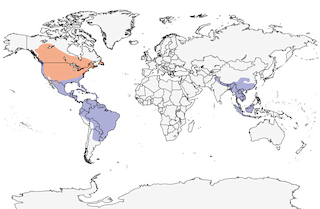
- Year-round
- Breeding
- Non-breeding
Full content is available exclusively to Birds of the World subscribers. Sign in Learn more
Introduction
Until recently, vireos were a biogeographic puzzle, their relations with the Old World corvoids proving hard to reconcile with their striking diversity and apparent endemism in the New World. This paradox has recently been resolved by molecular data, which showed that the Pteruthius shrike-babblers and the monotypic genus Erpornis of southern Asia are actually vireonids after all. These are all small, big-billed, arboreal birds of woodlands and forests, with many of the North American species known for their indefatigable all-day singing. For some as yet unknown reason, several species have distinctive colors of the feet and legs, blue in many species of the Western Hemisphere and pink in some from Asia.
General Habitat
Diet and Foraging
Breeding
Conservation Status
Systematics History
Conservation Status
| Least Concern |
75.8%
|
|---|---|
| Near Threatened |
6.1%
|
| Vulnerable |
3%
|
| Endangered |
0%
|
| Critically Endangered |
0%
|
| Extinct in the Wild |
0%
|
| Extinct |
0%
|
| Not Evaluated |
0%
|
| Data Deficient |
0%
|
| Unknown |
15.2%
|
Data provided by IUCN (2025) Red List. More information